Will ChatGPT Recommend Your DPC Practice? How AI Is Changing the Way Patients Find Doctors
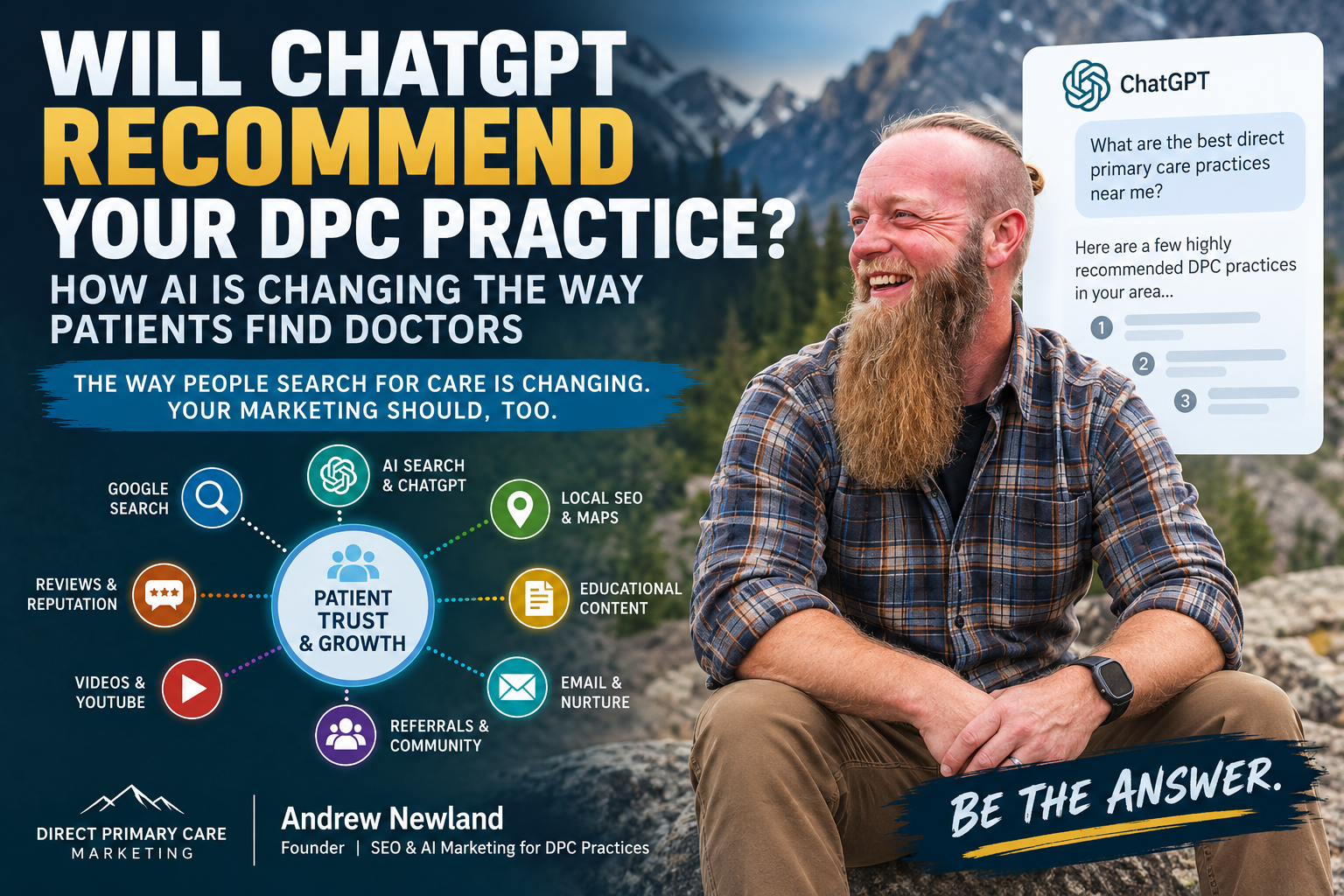
For years, Direct Primary Care practices have competed for a familiar Google search:
“Direct primary care near me.”
A prospective patient would type a few words into Google, scan the results, visit two or three websites, and hopefully schedule a consultation.
But imagine that same patient searching a little differently.
Instead of opening Google, she asks ChatGPT:
“I’m looking for a primary care doctor near me who offers longer appointments and would be a good fit for my family. What practices should I consider?”
Within seconds, she gets a handful of recommendations.
The question for DPC physicians is becoming:
Is your practice one of them?
Welcome to the next evolution of SEO.
Patients Aren’t Just Searching. They’re Asking.
Google fundamentally changed how patients found doctors. Now artificial intelligence is changing it again.
Tools such as ChatGPT, Google’s AI-powered search experiences, Gemini, Perplexity, and other AI assistants allow consumers to search conversationally.
Instead of typing:
DPC doctor Denver
A patient can ask:
“What are some highly rated direct primary care practices near Denver that work with families, have transparent pricing, and offer same-day appointments?”
That distinction matters.
Traditional search engines primarily helped people find information.
AI increasingly helps people evaluate options.
And that means being ranked on Google may no longer be the only visibility metric DPC practices need to care about.
SEO Isn’t Dead. It’s Just Expanding.
Every few years, something supposedly “kills SEO.”
Social media was going to kill it.
Voice search was going to kill it.
TikTok was going to kill it.
Now AI is supposedly going to kill it.
That isn’t what we’re seeing. AT ALL!
Instead, search engine optimization is expanding into something broader.
At our agency, we think about this as SEO + AIO: Search Engine Optimization plus Artificial Intelligence Optimization.
Traditional SEO asks:
Can Google find, understand, and rank my practice?
AIO adds another question:
Can AI systems understand who we are, what we do, where we operate and why they should consider us a credible recommendation?
Those two objectives overlap considerably.
In fact, many of the things that have historically made a DPC practice strong in organic search also help create the kind of digital footprint AI systems can understand.
AI Needs to Understand Your Practice
Imagine two DPC practices operating in the same city.
Practice A has a five-page website.
Its homepage says things like:
Healthcare done differently.
Experience personalized medicine.
We put patients first.
Those statements sound nice.
But they don’t tell a search engine—or an AI system—very much.
Practice B has clearly defined information about:
- Who its physicians are and their credentials
- What Direct Primary Care is
- Who the practice serves
- Where the practice is located
- How its membership works
- What services are included
- What conditions the physicians commonly address
- How DPC differs from insurance-based primary care
- Frequently asked patient questions
- Educational resources written by its physicians
Across the web, Practice B also has reviews, directory listings, interviews, local mentions, and other references that reinforce this information.
Which practice is easier for an AI system to understand?
Almost certainly Practice B.
This is one of the central ideas behind AIO.
You can’t expect AI to confidently recommend an organization it barely understands.
Your Website Is Only One Piece of the Puzzle
This is where AI optimization gets especially interesting.
For traditional SEO, practices have understandably concentrated heavily on their websites.
Your website still matters enormously.
But AI systems can encounter information about your practice across a much larger digital ecosystem.
That can include your Google Business Profile, physician bios, professional directories, local news coverage, podcasts, reviews, social profiles, industry websites, and other credible references to your practice or physicians.
Think about it as building a digital reputation that machines can understand.
If your website says you’re an established DPC authority but almost nothing else on the internet confirms that, there may be limited evidence supporting the claim.
Conversely, if your physicians publish useful content, appear on podcasts, contribute to respected websites, receive consistent reviews and are mentioned by relevant organizations, the digital picture becomes much clearer.
This isn’t about gaming ChatGPT.
It’s about creating enough legitimate evidence online that both people and machines can understand your expertise.
Stop Writing Blogs Just to Target Keywords
AI search should also change how DPC practices think about content.
For years, SEO agencies often started with keywords.
They’d discover that 500 people searched for a particular phrase and then write an article targeting it.
There is still value in keyword research.
But conversational AI allows prospective patients to ask much more complicated questions.
Consider the difference between:
“Direct primary care cost”
and:
“Would direct primary care actually save my family money if we already have a high-deductible health plan?”
The second question reveals far more about the patient’s real concern.
DPC practices should increasingly build content around these kinds of questions.
For example:
Can I use an HSA with Direct Primary Care?
Do I still need health insurance if I join a DPC practice?
Is DPC worth it if I’m healthy and rarely see a doctor?
Can my employer pay for my DPC membership?
What’s the difference between concierge medicine and Direct Primary Care?
Can a DPC physician manage chronic conditions?
What happens if I need to see a specialist?
These aren’t merely SEO keywords.
They’re actual patient decisions.
And answering them thoroughly gives search engines, AI systems, and prospective patients better information about your practice.
Local Authority May Become Even More Important
There’s another important consideration for DPC.
Healthcare is local.
A patient isn’t usually looking for the world’s foremost authority on Direct Primary Care.
They’re trying to determine:
Who should I trust near me?
That makes local authority extremely valuable.
A DPC physician who is interviewed by a local newspaper, appears on a regional podcast, speaks to local employers, contributes to community organizations and earns legitimate patient reviews isn’t simply generating publicity.
They’re creating independent signals connecting:
Doctor + Direct Primary Care + Location + Expertise
Those connections help build a recognizable digital entity around the physician and practice.
And that’s potentially valuable whether the person searching uses Google, Maps, ChatGPT or whatever search technology comes next.
Don’t Forget the Fundamentals
It’s tempting to treat AIO as an entirely new marketing channel and start looking for tricks.
That would be a mistake.
Before worrying about advanced AI optimization, DPC practices should make sure the fundamentals are strong.
Can someone immediately determine where you’re located?
Is your physician’s full name and professional background clearly presented?
Can Google understand your services?
Do you have dedicated pages explaining important aspects of your practice?
Is your membership pricing easy to find?
Are your business details consistent across the internet?
Are patients reviewing your practice?
Are you producing genuinely useful content?
Are other reputable websites mentioning you?
These things aren’t glamorous.
But they’re exactly the kind of foundation that helps establish digital authority.
Start Testing Your Own Practice
Here’s a simple exercise every DPC owner can try.
Open several AI platforms and ask questions a prospective patient might actually ask.
Try:
“What are the best Direct Primary Care practices in [your city]?”
Then get more specific.
“What DPC practices in [your city] are good for families?”
“Which Direct Primary Care doctors near [your city] have strong reviews?”
“I’m looking for a DPC physician in [your city] who focuses on prevention and spends more time with patients. Who should I consider?”
Look at what comes back.
Does your practice appear?
Which competitors do?
More importantly:
Why might those practices be appearing?
Search for them.
Examine their websites.
Look at their reviews, physician profiles, content, citations, media appearances and overall digital presence.
You’re beginning to see your market through a very different lens.
The Goal Isn’t Ranking. It’s Being the Answer.
For the last 20 years, digital marketing has largely been about getting into the search results.
First page.
Top five.
Top three.
Position one.
AI introduces a different objective.
Instead of simply asking:
“Do we rank?”
DPC practices increasingly need to ask:
“Are we part of the answer?”
That shift could become one of the most significant changes in healthcare marketing since Google became the dominant way patients searched for doctors.
Nobody knows exactly what AI-powered search will look like five years from now.
But we don’t need to know.
The strategy is surprisingly durable.
Build a practice worth talking about.
Clearly communicate what makes it different.
Answer the questions patients are actually asking.
Publish genuinely useful information.
Establish your physicians as credible experts.
Build authority within your local community.
And make sure the internet contains enough consistent, trustworthy information to understand exactly who you are.
Do those things well, and you’ll be positioning your DPC practice for something bigger than rankings.
You’ll be positioning it to become the answer.
Learn more about how Direct Primary Care Marketing can help you.
Author: Andrew Newland
Home





Thank you! Your article provided a lot of useful information.