The Death of Organic Social Media for Patient Acquisition — And What DPC Practices Must Do Instead
For years, Direct Primary Care practices were told that consistent posting on Facebook and Instagram would naturally lead to patient growth. The logic sounded simple: post valuable content, build trust, grow followers, and patients will come.
In 2026, that model is no longer reliable — and in many cases, it was never as effective as people believed.
Today, organic social media should be viewed as a trust reinforcement channel, not a primary patient acquisition engine. For DPC practices focused on sustainable growth, the foundation of marketing strategy must now be built on search visibility (SEO), AI search optimization (AIO), and strategic paid amplification through Google and Meta ads.
The Reality: Organic Social Reach Is Extremely Limited
Across industries, organic visibility on major platforms has steadily declined.
Average Facebook organic reach often falls between 1–2% of followers. That means if a practice has 2,000 followers, only 20–40 people may see a typical post.
Instagram performs slightly better, but average organic reach typically lands around 3–5% of followers, and continues trending downward year over year.
Even video — once considered the organic growth solution — is no longer a guarantee. Algorithms prioritize entertainment, trending audio, and creator-style content over educational or informational healthcare content. DPC practices are often competing with lifestyle creators, influencers, and entertainment media for attention.
The result: practices can post consistently, produce high-quality content, and still reach only a tiny portion of their potential audience.
The Modern Patient Journey Has Changed
To understand why organic social has shifted to a supporting role, you have to look at how patients actually find and evaluate healthcare providers today.
The typical journey now looks like this:
Step 1: Discovery Happens on Google or AI Platforms
Patients search:
- “Direct primary care near me”
- “Doctor membership instead of insurance”
- “Best doctor for chronic fatigue / hormones / metabolic health”
Increasingly, patients are also using AI search assistants that summarize local provider options before they ever click a website.
If a DPC practice is not visible in search results or AI knowledge summaries, it may never enter the patient’s consideration set.
Step 2: Patients Visit the Website First
Once discovered, patients almost always visit the website before doing anything else.
They are looking for:
- Clear explanation of the DPC model
- Pricing transparency
- Services and condition focus
- Physician philosophy and credibility
- Ease of joining
The website is where most conversion decisions begin forming.
Step 3: Social Media Becomes Due Diligence
Only after search and website evaluation do many patients check social media.
At this stage, they are not discovering you — they are validating you.
They are looking for:
- Is this practice active?
- Does this doctor seem trustworthy and relatable?
- Do patients appear happy?
- Does this practice feel established and stable?
Organic social still matters — but mostly as credibility proof.
Why SEO and AIO Must Be the Foundation of DPC Marketing
Search and AI discovery represent high-intent traffic. These are patients already looking for solutions, often ready to join or book consults.
NOTE: Comprehensive SEO/AIO is not just flipping some switches on the back end of your website!
Strong DPC marketing foundations now require:
Comprehensive SEO
- Local search dominance
- Condition-based content authority
- Technical website optimization
- Entity and medical authority signals
AI Optimization (AIO)
- Structured data and schema
- Content depth and topical authority
- Brand and entity consistency across platforms
- Knowledge graph visibility
Practices that invest here position themselves where patients are already looking.
The Role of Google and Meta Ads: Strategic Acceleration
Paid advertising is not a replacement for SEO and AIO — it is a growth accelerator.
Google Ads capture immediate high-intent searches while organic rankings build.
Meta Ads create targeted awareness and retarget website visitors who are evaluating options.
Together, they shorten time-to-membership growth.
Where Organic Social Media Still Matters
Organic social still plays an important role — just not the one many practices were promised.
It works best for:
- Trust reinforcement
- Patient culture storytelling
- Retention and community building
- Supporting conversion during the research phase
Think of social media as your digital waiting room, not your primary lead generator.
The Future of DPC Marketing Strategy
The most successful DPC practices moving forward will build marketing around this hierarchy:
Foundation:
SEO + AI Search Optimization
Acceleration:
Google Ads + Meta Ads
Support and Trust Layer:
Organic Social Media
Final Thought
Patients are not starting their healthcare journey on social media. They are starting with search — increasingly powered by AI — then validating credibility through websites and social presence.
DPC practices that recognize this shift will build more predictable, scalable growth systems.
Those that rely primarily on organic social posting risk becoming invisible to the very patients they are trying to serve.
Not all SEO and AI search optimization strategies are created equal. In DPC, success is rarely driven by generic healthcare marketing tactics. It requires a comprehensive approach that aligns technical optimization, authoritative education content, and local search authority with how patients actually research membership-based care in search engines and AI platforms.
Author:
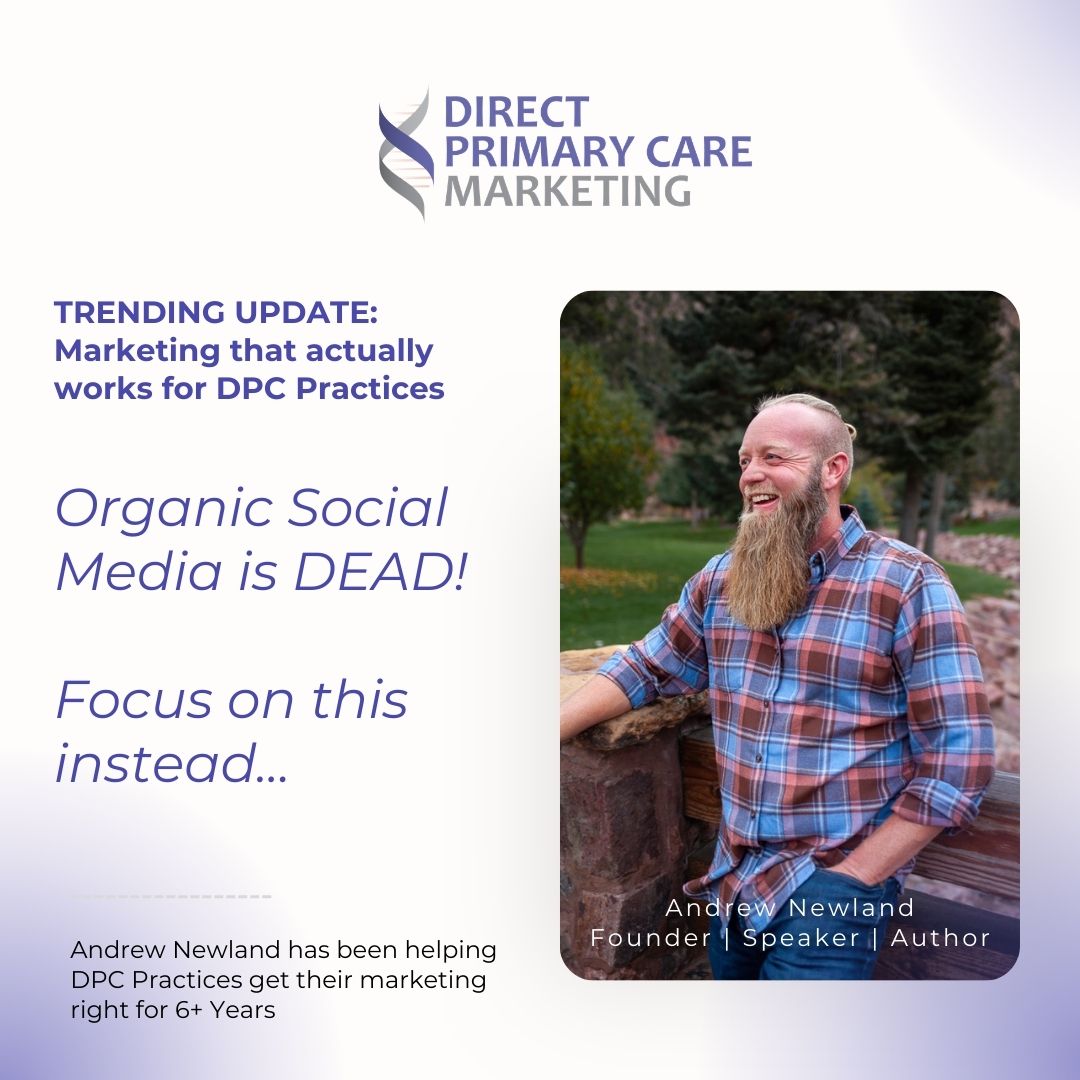
Andrew Newland – Direct Primary Care Marketing