State of Direct Primary Care Report Reveals New Reality of America’s Growing Physician-Led Healthcare Movement
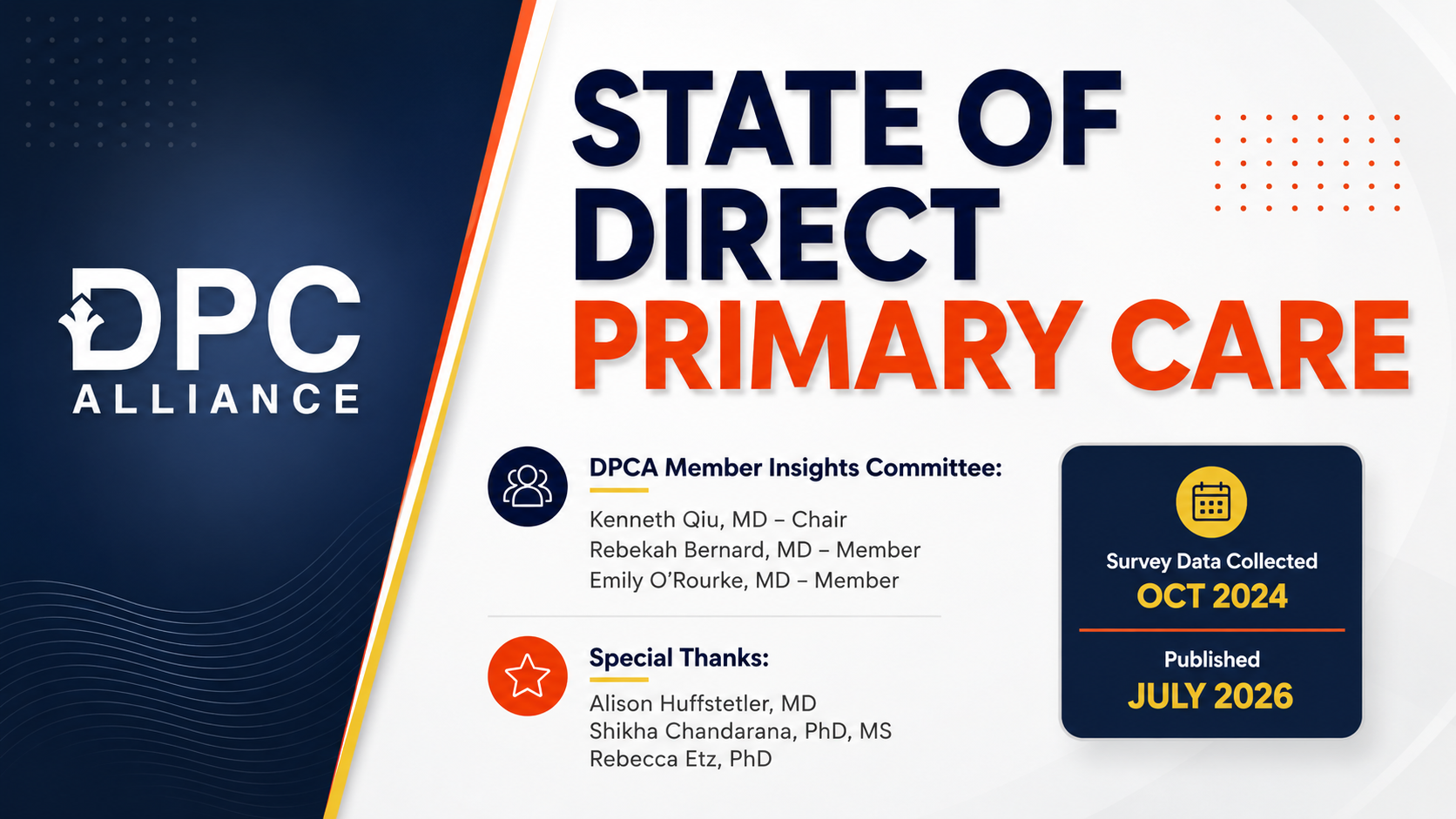
The Direct Primary Care Alliance (www.DPCAlliance.org) released its State of Direct Primary Care Report, providing one of the most comprehensive examinations of the Direct Primary Care (DPC) movement to date and offering new insights into how physicians across the country are building sustainable, patient-centered practices.
Based on 465 survey responses representing approximately 13 percent of an estimated 3,600 Direct Primary Care practices nationwide, the report paints a picture of a healthcare model that continues to evolve while challenging several assumptions that have circulated within the industry for more than a decade.
The survey was developed by the DPC Alliance Member Insights Committee, reviewed by healthcare research experts and the Alliance Board of Directors, and supported by statistical analysis to ensure meaningful and reliable results.
“We were amazed at how the community came together to participate,” said Dr. Kenneth Qiu, Chair of the DPC Alliance Member Insights Committee. “This report provides a unique snapshot of where Direct Primary Care stands today and helps us better understand the physicians who are driving the movement forward.”
Among the report’s most surprising findings was the average monthly membership fee. For years, the DPC community has frequently cited an average membership price of approximately $77 per month based on data collected more than a decade ago. The new survey found the national average membership fee to be $98.46 per month, indicating that practices have continued to mature and adapt to changing economic realities while delivering expanded value to patients.
The report also challenges another commonly accepted benchmark regarding patient panel size. While many physicians have historically viewed 600 patients as the standard for a “full” Direct Primary Care practice, survey respondents revealed a much more diverse reality. Many physicians reported being fully satisfied and operating at capacity with patient panels between 100 and 300 patients, while others clustered between 400 and 700 patients. The findings suggest there is no single formula for success in Direct Primary Care.
“What we found fascinating was that these physicians told us they were full, happy, and not looking to grow further,” noted Dr. Rebekah Bernard, a member of the DPC Alliance Member Insights Committee. “Many are thriving with panel sizes significantly smaller than what has traditionally been considered the norm.”
The report further highlights the entrepreneurial nature of the DPC movement. Eighty-two percent of respondents reported being full owners of their practices, demonstrating a strong trend toward physician independence and practice ownership.
Staffing data revealed another significant finding: more than 30 percent of respondents reported operating without any staff members at all. These physician-led micro practices represent a growing segment of the DPC landscape, enabled by simplified administrative requirements and direct physician-patient relationships.
The survey also found that female physicians represented the majority of respondents. Committee members suggested this may reflect the appeal of Direct Primary Care for physicians seeking greater control over their schedules, improved work-life balance, and an alternative to the increasing administrative burdens associated with traditional healthcare models.
“Direct Primary Care may represent a viable pathway for physicians who otherwise might leave medicine altogether,” observed Dr. Bernard.
Additional findings revealed that most respondents operated single-physician, single-location practices, with relatively few utilizing nurse practitioners or physician assistants. Family medicine physicians represented the largest specialty group among respondents, followed by internal medicine physicians and pediatricians.
“The survey results show how easy it is to start your own DPC practice with just a few thousand dollars,” added Dr. Emily O’Rourke, a member of the DPC Alliance Member Insights Committee.
Geographically, Texas and Florida generated the highest number of survey responses, reflecting the strong presence of Direct Primary Care in those states. Committee members also noted a concentration of DPC practices in states that did not expand Medicaid, suggesting the model may play an important role in expanding healthcare access for underserved populations.
Dr. Kelsey Smith, President of the Direct Primary Care Alliance, emphasized that the report was created to benefit the entire DPC community. “This report doesn’t belong only to the Alliance,” Dr. Smith said. “It belongs to the community at large. We hope physicians use these findings to make better decisions, strengthen their practices, and continue advancing the Direct Primary Care movement.”
As healthcare leaders, employers, policymakers, and patients continue searching for innovative solutions to rising costs and limited access to care, the State of Direct Primary Care Report offers valuable insight into a physician-led model that continues to gain momentum nationwide.
The complete report and accompanying Member Insights Committee discussion are available at https://www.dpcalliance.org/dpc-2024-survey-results.
About the Direct Primary Care Alliance:
The Direct Primary Care Alliance is a national physician-led organization dedicated to supporting, promoting, and advancing the Direct Primary Care model through education, advocacy, mentorship, research, and community-building initiatives. The Alliance works to strengthen the DPC movement and empower physicians to deliver high-quality, relationship-centered care to patients across the United States. More at www.dpcalliance.org.