How to Grow Your DPC Practice Without Becoming a Social Media Influencer
Let’s start with something I think a lot of Direct Primary Care practitioners need to hear:
You do not need to become a social media influencer to grow a successful DPC practice.
You don’t need to dance on TikTok, record Instagram Reels between patient appointments, or spend your evenings figuring out what to post next.
And you certainly don’t need to become a full-time content creator on top of being a physician and business owner.
As someone who works with Direct Primary Care practices on their marketing and growth strategies, I’ve seen how much pressure physicians feel to be everywhere online.
Instagram. Facebook. YouTube. TikTok. LinkedIn.
The message seems to be that if you’re not constantly creating content, you’re falling behind.
But here’s what I tell physicians: Social media is one way to grow your practice. It isn’t the only way, and it may not even be the best place to invest your limited time.
There are effective, sustainable ways to attract new DPC members without ever pointing a camera at yourself.
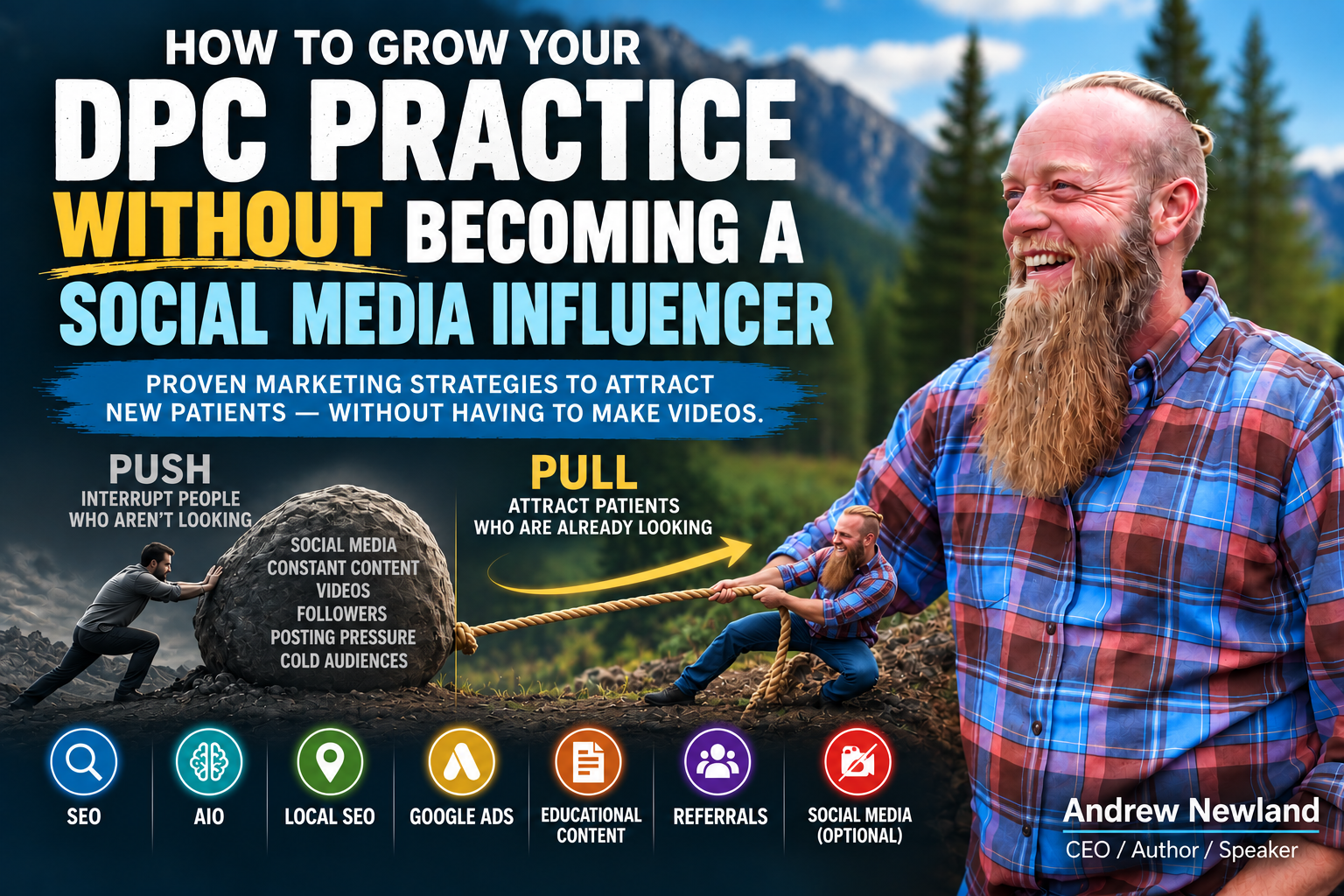
The Secret to Effective Marketing: Pull the Rope, Don’t Push It
Imagine laying a long rope on the ground.
If you try to push it from one end, what happens? It bunches up, twists, and goes nowhere.
But when you pull it, the entire rope follows.
Marketing works much the same way.
Many physicians approach marketing by trying to push their message in front of as many people as possible. They post constantly, create videos, and compete for attention in crowded social media feeds.
There’s nothing inherently wrong with that approach. But it can require tremendous effort, especially when you’re trying to reach people who aren’t actively looking for a new doctor.
What if, instead of pushing your message at potential patients, you positioned your practice so patients who are already searching for better healthcare could find you?
That’s pulling the rope.
And it’s the foundation of the marketing strategies I recommend to DPC practice owners. You don’t have to become an influencer.
1. Focus on Patients Who Are Already Looking for a Clinician to Trust on Google
One of the biggest differences between social media marketing and search engine marketing is intent.
When someone scrolls through Instagram, they’re usually not actively looking for a new primary care physician.
But when someone searches Google for:
- “Direct Primary Care near me”
- “Primary care doctor without insurance”
- “Affordable family doctor in [city]”
- “Doctor with longer appointments”
- “DPC membership cost”
They’re expressing a specific need.
That’s an entirely different opportunity.
With a strong SEO (Search Engine Optimization) strategy, your website can appear when prospective patients are actively researching their healthcare options.
This includes optimizing your website, building helpful educational content, improving your local search presence, and making sure search engines understand what your practice offers.
Unlike a social media post that may disappear from someone’s feed within hours, a well-optimized website page can continue attracting potential patients for months or years.
My recommendation: Before spending hours making social media videos, make sure your practice is visible when someone in your community searches for the healthcare services you provide.
That’s pulling the rope instead of pushing it.
2. Position Your Practice for AI Search (ChatGPT, Claude etc.)
The way patients search for healthcare is changing.
Increasingly, people are turning to AI-powered platforms like ChatGPT and Google’s AI search experiences to research their healthcare options.
Instead of typing a few keywords into Google, prospective patients can now ask detailed questions like:
- “Is Direct Primary Care worth it for a family of four?”
- “What are the best alternatives to traditional primary care?”
- “Can you recommend a DPC doctor in my area?”
- “How does DPC work if I already have health insurance?”
This creates another opportunity for DPC practices to be discovered by patients who are already exploring a different approach to healthcare.
AI Optimization (AIO) is the process of improving your digital presence so AI-powered search systems can more easily discover, understand, and potentially recommend your practice.
While traditional SEO focuses heavily on search engine visibility, AIO also considers how your practice’s information is interpreted and surfaced in AI-generated responses.
That means developing clear, authoritative website content, answering common patient questions, maintaining accurate business information, and establishing your physicians as credible experts.
It’s important to understand that nobody can guarantee your practice will be recommended by ChatGPT or other AI platforms.
But a strong combination of SEO and AIO can help position your practice for both traditional and emerging search experiences.
And the best part?
You don’t have to film a single video to get started.
3. Make Your Google Business Profile Work Harder
If I could recommend one free marketing tool that every DPC practice should take seriously, it would be Google Business Profile.
When patients search for local physicians, Google often displays a map with nearby practices.
Your Google Business Profile helps determine how your practice is represented in those local results.
And there are several things you can do to improve its effectiveness without ever recording a video.
Start with the fundamentals:
- Choose accurate business categories and complete your profile.
- Make sure your hours, address, phone number, and website are correct.
- Add professional photos of your office, team, and physicians.
- Encourage patients to leave honest reviews without offering incentives.
- Keep your services and business information updated.
- Post content (posts/updates) and link to different pages/blogs on your website
For DPC practices, reviews can be especially valuable because your entire model is built around relationships and trust.
A prospective patient reading about someone’s experience with longer appointments, better communication, and a more personal relationship with their physician may begin to understand what makes DPC different.
Remember, you aren’t simply competing with other DPC practices. You’re often competing with an entire healthcare model that patients have used their whole lives.
Your online presence needs to help explain why your approach is different.
4. Use Google Ads to Reach Patients Ready for a Change
SEO and AIO are excellent long-term investments, but they take time.
For practices looking to accelerate membership growth, Google Search Ads can be a powerful complement.
Instead of hoping someone discovers your latest social media post, Google Ads allows you to reach people searching for relevant healthcare services in your area.
You can target searches related to Direct Primary Care, family medicine, membership-based healthcare, and alternatives to traditional primary care.
Think about our rope analogy again.
With Google Ads, you’re not trying to convince someone scrolling through vacation photos to suddenly think about switching doctors.
You’re reaching someone who has already raised their hand by searching for a healthcare solution.
Of course, simply running ads isn’t enough.
The real opportunity comes from connecting those ads to well-designed landing pages that clearly explain your membership model, communicate your value, and make it easy to schedule a discovery call or introductory appointment.
I often remind physicians that generating website traffic is not the same thing as generating new members.
The goal isn’t more clicks. The goal is more patients who understand and value what you offer.
That requires the right message, the right audience, and a simple path from initial interest to enrollment.
5. Combine ChatGPT Ads with Your Organic AI Strategy
One of the newer opportunities I’m particularly excited about for DPC practices is advertising within ChatGPT.
Think about the difference between someone scrolling through social media and someone having a conversation with AI about their healthcare options.
A prospective patient might ask ChatGPT:
- “Is Direct Primary Care worth it for my family?”
- “What are the best alternatives to traditional health insurance?”
- “How can I find a doctor who spends more time with patients?”
- “Are there DPC practices near me?”
These conversations can reveal something incredibly valuable in marketing: intent.
Rather than trying to interrupt someone who isn’t thinking about healthcare, ChatGPT advertising creates opportunities to reach people while they’re actively exploring questions relevant to your practice.
This is where I see a particularly compelling opportunity to combine paid advertising with organic AI Optimization (AIO).
Your organic strategy helps AI-powered search platforms discover and understand your practice through educational content, technical optimization, and a strong online presence.
ChatGPT Ads offer an additional paid opportunity to introduce your practice in relevant conversations, where advertising is available and eligible.
The two strategies serve different purposes, but they can complement each other.
Organic AIO builds long-term visibility and credibility. ChatGPT Ads can create additional opportunities for discovery while that organic presence develops.
Importantly, paid advertising does not influence ChatGPT’s organic answers or recommendations. Ads are separate, clearly labeled placements.
And like Google Ads, success depends on more than simply getting your practice in front of someone. Your messaging, targeting opportunities, landing page, and enrollment process all matter.
This brings us right back to the rope analogy.
Instead of constantly pushing your practice into crowded social media feeds, you’re investing in channels that can connect you with people already asking questions about better healthcare options.
And you can do it without ever stepping in front of a camera.
6. Let Your Website Do the Educating for You
Here’s a common challenge I see with DPC websites.
They explain what the practice does, but they don’t adequately answer the questions that keep patients from joining.
Think about the conversations you have with prospective members.
Can I still have health insurance?
What if I rarely go to the doctor?
Does this replace my insurance?
Can my entire family join?
What happens if I need a specialist?
Those questions should be answered clearly on your website.
One of the most effective marketing strategies for DPC is developing educational pages and articles that address these concerns.
This content supports both traditional SEO and AIO, helping search engines and AI platforms better understand your practice.
And here’s the good news: You don’t have to write all of it yourself.
A knowledgeable marketing partner can interview you, learn your approach, and turn your expertise into helpful, accurate content that you review before publication.
You provide the medical expertise. Your marketing team handles the content development, optimization, and publishing.
The result is a website that educates prospective patients around the clock, even when you’re busy seeing patients.
7. If You Want Social Media, You Still Don’t Have to Be on Camera
I don’t want to give the impression that social media is ineffective.
It can absolutely play a valuable role in DPC marketing.
But there’s a significant difference between using social media strategically and feeling obligated to become a content creator.
Your practice can maintain an engaging social media presence through educational graphics, written posts, patient FAQs, practice updates, and professionally designed content.
You can also run targeted Facebook and Instagram advertising campaigns without regularly filming yourself.
And if you occasionally want to record a short educational video, great.
But that should be a choice, not a requirement for your marketing strategy.
The Real Secret: Build a Marketing System, Not Another Job
This is the point I want every DPC physician to understand.
You chose Direct Primary Care because you wanted to practice medicine differently.
You wanted more time with patients, greater autonomy, and the freedom to build a practice around meaningful relationships.
The last thing you need is a marketing strategy that creates another full-time job.
In my experience, sustainable DPC growth comes from building a connected marketing system.
Your website attracts and educates prospective members. Your Google Business Profile strengthens local visibility. SEO and AIO help patients discover you through traditional and AI-powered search. Paid advertising accelerates discovery. Community relationships build trust.
Each component supports the others.
And most importantly, the system doesn’t depend on you creating new videos every week.
That doesn’t mean marketing becomes completely hands-off. Your practice still needs to communicate its unique value, participate in important decisions, and maintain a great patient experience.
But the heavy lifting shouldn’t fall entirely on the physician.
My Advice to DPC Physicians
If you love making videos and connecting with patients on social media, keep doing it.
Authentic physician-led content can be valuable.
But if the thought of filming another Reel makes you want to throw your phone across the room, I have good news.
You have options.
Start by making sure patients can find you on Google and through emerging AI search platforms. Build a website that answers their questions. Develop local referral relationships. Invest in marketing channels that connect you with people already interested in a better healthcare experience.
And when possible, delegate the technical and creative work to people who specialize in it.
Remember the rope.
You can spend your time pushing your message toward people who may not be interested, or you can build a marketing strategy that pulls interested patients toward your practice.
Both approaches have their place. But for busy DPC physicians, I believe the second deserves far more attention.
You became a DPC physician to spend more time practicing medicine, not more time creating content.
Your marketing strategy should support that decision, not work against it.
About the Author
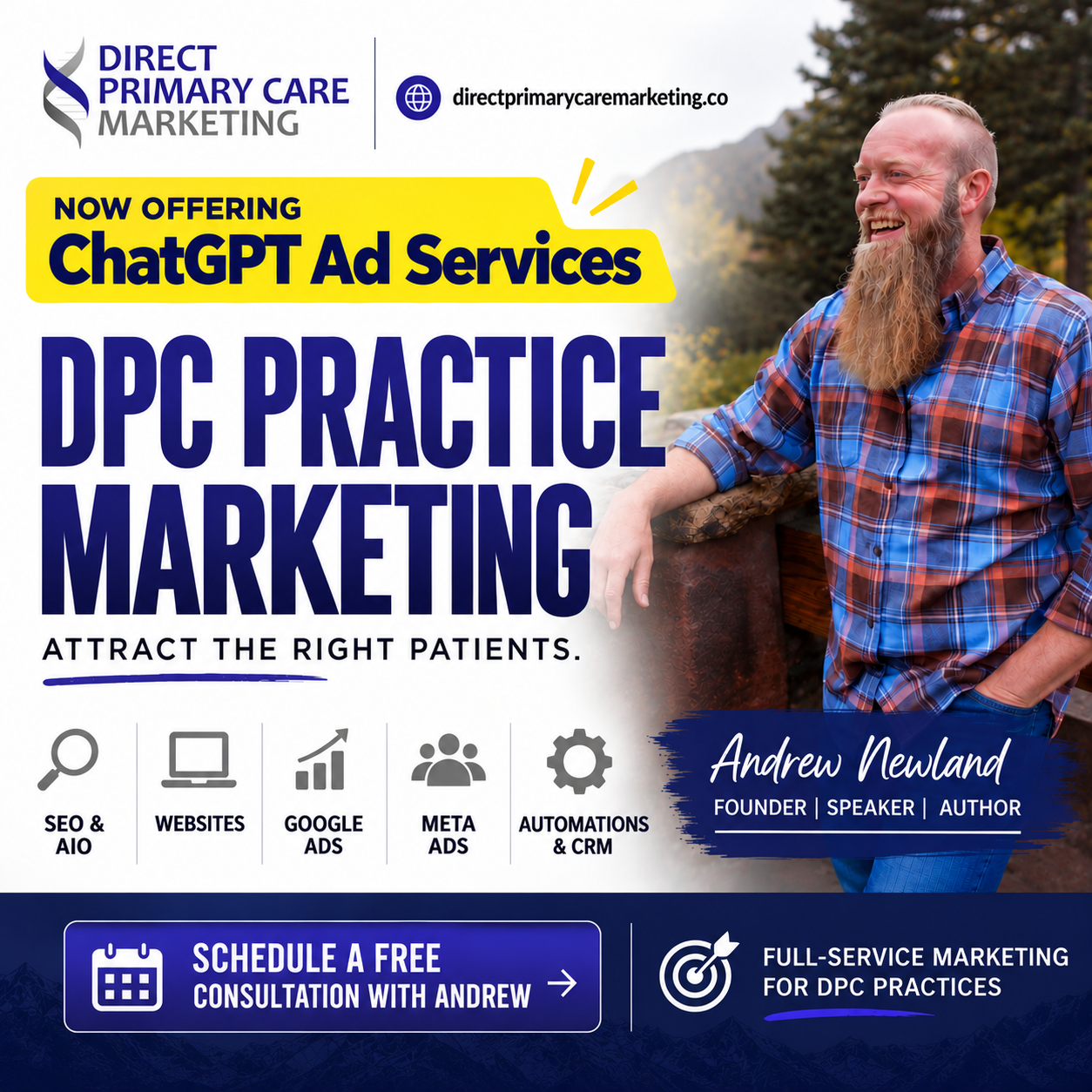
Andrew Newland is the Co-Founder of Direct Primary Care Marketing, a marketing agency specializing in helping Direct Primary Care practices grow through SEO, AI search optimization, Google Ads, Meta advertising, website development, and strategic patient acquisition. Andrew and his team help independent physicians build sustainable marketing systems so they can focus on what matters most: caring for their patients.