Written by me…AI tried first
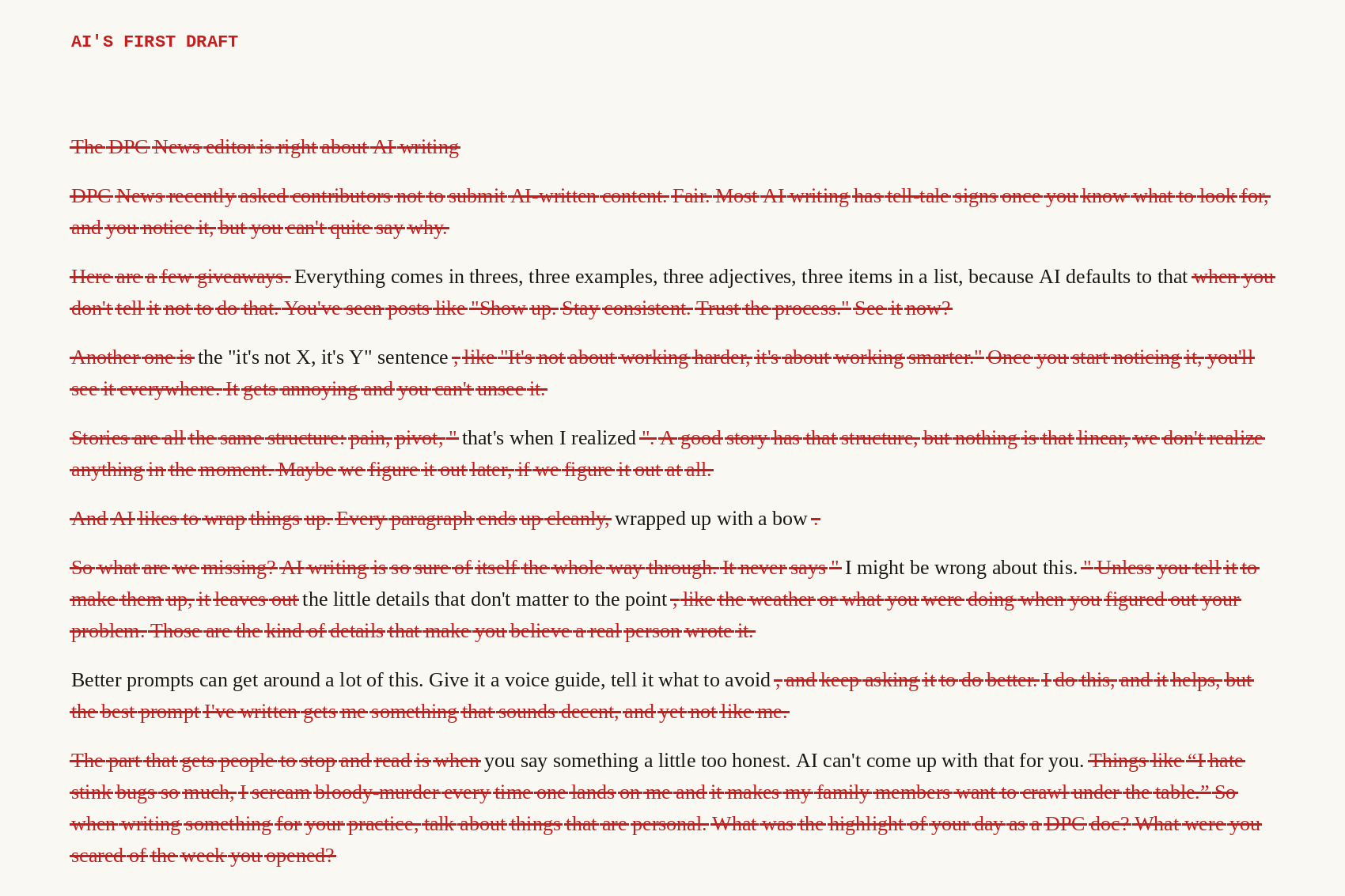
(Full disclosure: I started this post with an AI draft. The italics are what’s still standing from that first draft. Everything else got rewritten, cut, or replaced somewhere across six or seven passes. That’s the real point. You can’t use the first draft.)
I can spot AI writing almost instantly now, in posts online, or even one of my own drafts. Once you see the patterns enough times, you can’t unsee them, and lately I’ve been trying hard to get them out of my own writing. I’m not giving up AI, but I’m paying a lot more attention to what it gives me, and to what I actually keep.
Using AI in our writing matters more for us than for most businesses and practices. Joining a DPC is a decision based on relationships. If your posts sound like they could have come from any practice anywhere, you’re not giving people the best reasons why they should pick you.
Here are a few AI giveaways. Everything comes in threes, three examples, three adjectives, three items in a list, because AI defaults to that when you don’t tell it not to do that. You’ve seen posts like “Show up. Stay consistent. Trust the process.” See it now?
Another one is the “it’s not X, it’s Y” sentence, like “It’s not about working harder, it’s about working smarter.” Once you start noticing it, you’ll see it everywhere. It gets annoying and you can’t unsee it.
Stories are all the same structure: pain, pivot, “that’s when I realized.” A good story has that structure, but nothing is that linear, we don’t realize anything in the moment. Maybe we figure it out later, if we figure it out at all.
And AI likes to wrap things up. Every paragraph ends up cleanly, wrapped up with a bow.
So what are we missing? AI writing is so sure of itself the whole way through. It never says “I might be wrong about this.”It leaves out the little details that don’t matter to the point, like the weather or what you were doing when you figured out your problem. Those are the kind of details that make you believe a real person wrote it. Sometimes it makes up those details, trying to sound like a human. For this post, it took a story about a coaching call and added that it happened “on a Tuesday,” because it sounds specific. AI loves to have things on Tuesdays. Apparently nothing ever happens on a Wednesday.
Better prompts can get around a lot of this. Give it a voice guide, tell it what to avoid, and keep asking it to do better. I do this, and it helps, but the best prompt I’ve written gets me something that sounds decent, and yet not like me.
The part that gets people to stop and read is when you say something a little too honest. AI can’t come up with that for you. Things like “I hate stink bugs so much, I scream bloody murder every time one lands on me and it makes my family members want to crawl under the table.” So when writing something for your practice, talk about things that are personal. What was the highlight of your day as a DPC doc? What were you scared of the week you opened?
I still use AI, including for this post, but I went through 7 rewrites before getting here, so most of this IS me. AI gives me something to react to instead of starting from scratch, and that helps me figure out what I really want to say.
Before I start writing, I dictate my thoughts for what I’m writing and I tell it not to use the following things. But if some slip through on the first draft, here’s what I take out:
- Em dashes. (—) AI uses them constantly. I swap them for a period or a comma. If em dashes have always been your thing, then by all means keep on using them. Just know people like me are going to side-eye you now.
- “It’s not X, it’s Y” sentences. I rewrite them as one sentence that says what I mean.
- The last line of the paragraph. If it’s a neat summary, I try deleting it. The paragraph might be fine without it.
- Any made up details. Things like dates, numbers, quotes, “on a Tuesday.” If I can’t remember it being true, I delete it.
- Overused AI words and phrases. Quietly, weight, lands, feels heavy, it’s important to note, that’s not a small thing. If I haven’t used those phrases before, I change them out for my words.
Then I read it out loud, and I add something only I would know. (Like in the movies, tell me something embarrassing only you would know so I know it’s really you.)
No one wants to read AI slop, but it’s still a highly useful tool. I use AI for business planning, website ideas, marketing plans, setting up EOS (Entrepreneurial Operating System) in our practice, planning an event, drafting flyers for an open house, and even figuring out whether my choral society’s website could run on a different platform. And for writing, the best thing AI can do is show me what not to sound like.





Good points in this write up! I had to hire a new MA recently and used Indeed. Over 100 applicants and they all used AI for their resumes. They all “worked in a dynamic setting and in a fast paced work environment”. It was so bad that I had to conduct screening calls to see who I wanted to actually interview. It was a waste of mine and their time. Your article was helpful in knowing what to look for- thank you!