The Middlemen Conundrum
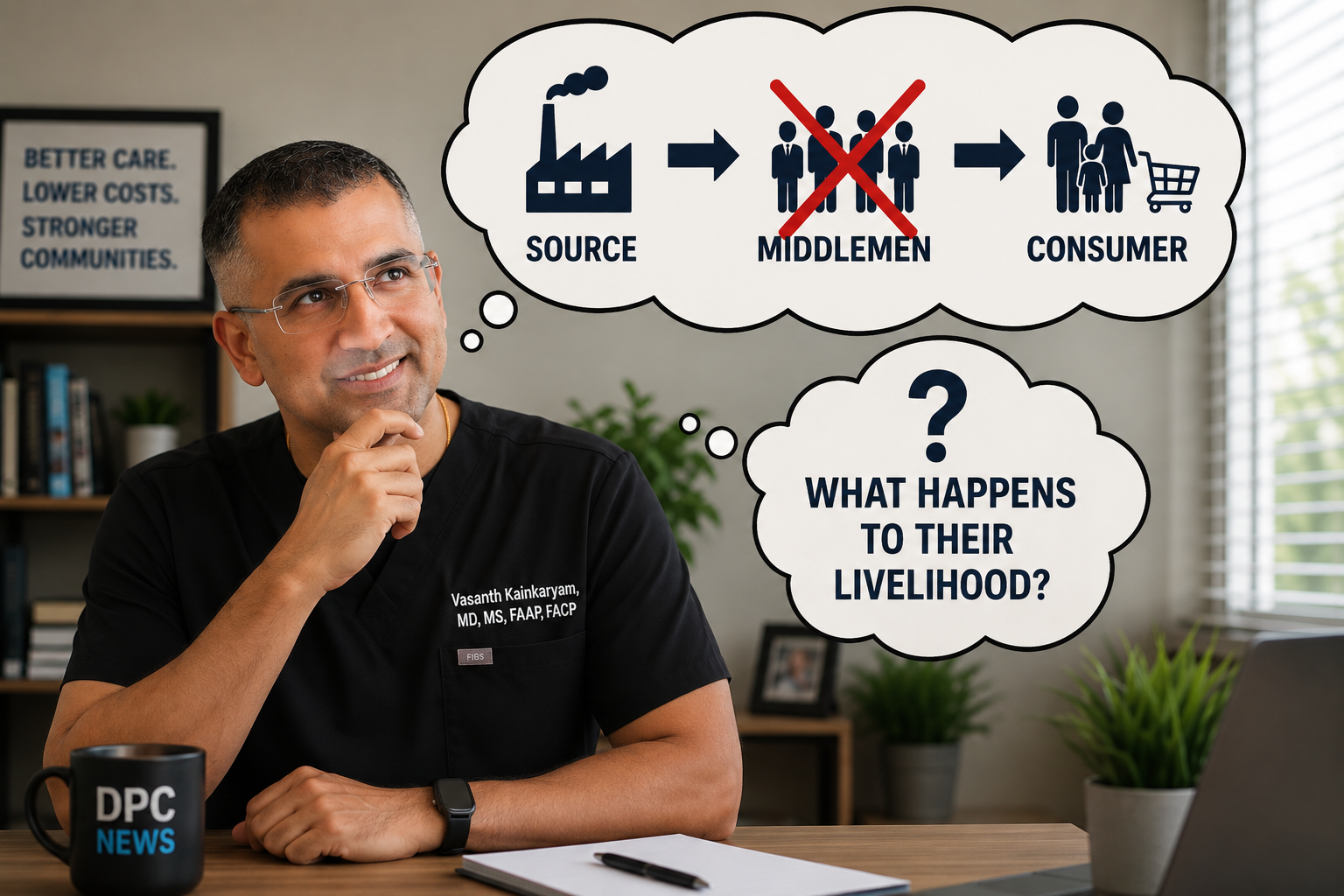
There’s an interesting philosophical discussion in health care.
In the direct care world, we talk about removing the middlemen—people who come in between and, in doing so, increase the cost of a product or service to the consumer.
For example, with a medication, you have:
- the manufacturer
- transportation and shipping
- research and development that went into it from the beginning
- wholesalers
- pharmacy benefit managers (PBMs)
- third-party administrators (TPAs)
- claims processors
- insurers
- and so on.
Ultimately, the cost of that medication gets dramatically increased.
In order to reduce cost, there is a growing movement toward direct contracting, where the goal is to source the product as close to the origin as possible in order to reduce the cost to the consumer.
The goal of the direct care model is simple: eliminate or reduce the middlemen in the process to deliver the lowest-cost product or service possible.
Perhaps this is such an important issue because health care is so expensive. Perhaps it is because medical bills remain one of the leading causes of personal bankruptcy. Whatever the reason, reducing unnecessary costs has become a major focus.
But it does raise an interesting philosophical question.
Many individuals earn their living by being the middlemen. Entire businesses are built around contracting, distribution, administration, and reselling—serving as the link between manufacturers, wholesalers, retailers, providers, insurers, and ultimately the consumer.
I find there to be a philosophical dilemma.
While you are helping the consumer by reducing the middlemen, are you also eliminating jobs, businesses, and livelihoods in the process? In a world where the cost of college and education is far more than many people make in the job market, are we inadvertently making it worse?
I’m not sure what the right answer is.
Perhaps health care is different because the difference between the original cost and the final price has become so extraordinarily large that reducing the number of intermediaries creates enormous value for the patient. Perhaps the administrative layers have grown beyond what is necessary. Or perhaps many of those intermediaries provide value that we simply don’t appreciate until they are gone.
I’m not sure.
I find myself left with this philosophical question:
While the direct care model focuses on helping the consumer, what happens to all of the middlemen we are trying to eliminate? What happens to their jobs, their opportunities, and their livelihoods?






They adapt.
Sure, eliminating these roles disrupts jobs, but that doesn’t mean it is something we should avoid. Your “interesting philosophical argument” confuses compassion with inefficiency. The purpose of a system is to serve patients well—affordably, transparently, and effectively—not to preserve roles that no longer contribute or worse, cause harm.
We’ve seen this story before. When cars replaced horses, we didn’t keep paying people to shovel manure just to protect their jobs. The work changed, and jobs and the people adapted. (Don’t need pooper scoopers or sources of hay, DO need mechanics, gas stations, etc.) The same applies here. If retail pharmacy or PBM functions are no longer necessary, maintaining them artificially just drives up costs and slows care and can be argued to cause harm.
DPC isn’t about cutting middlemen out for the sake of it—it’s about removing friction. If a middleman genuinely adds value, keep them. If not, the better move is to let the system evolve and help people transition into roles that actually improve care.