Primary Care: The Ultimate Code-Switching
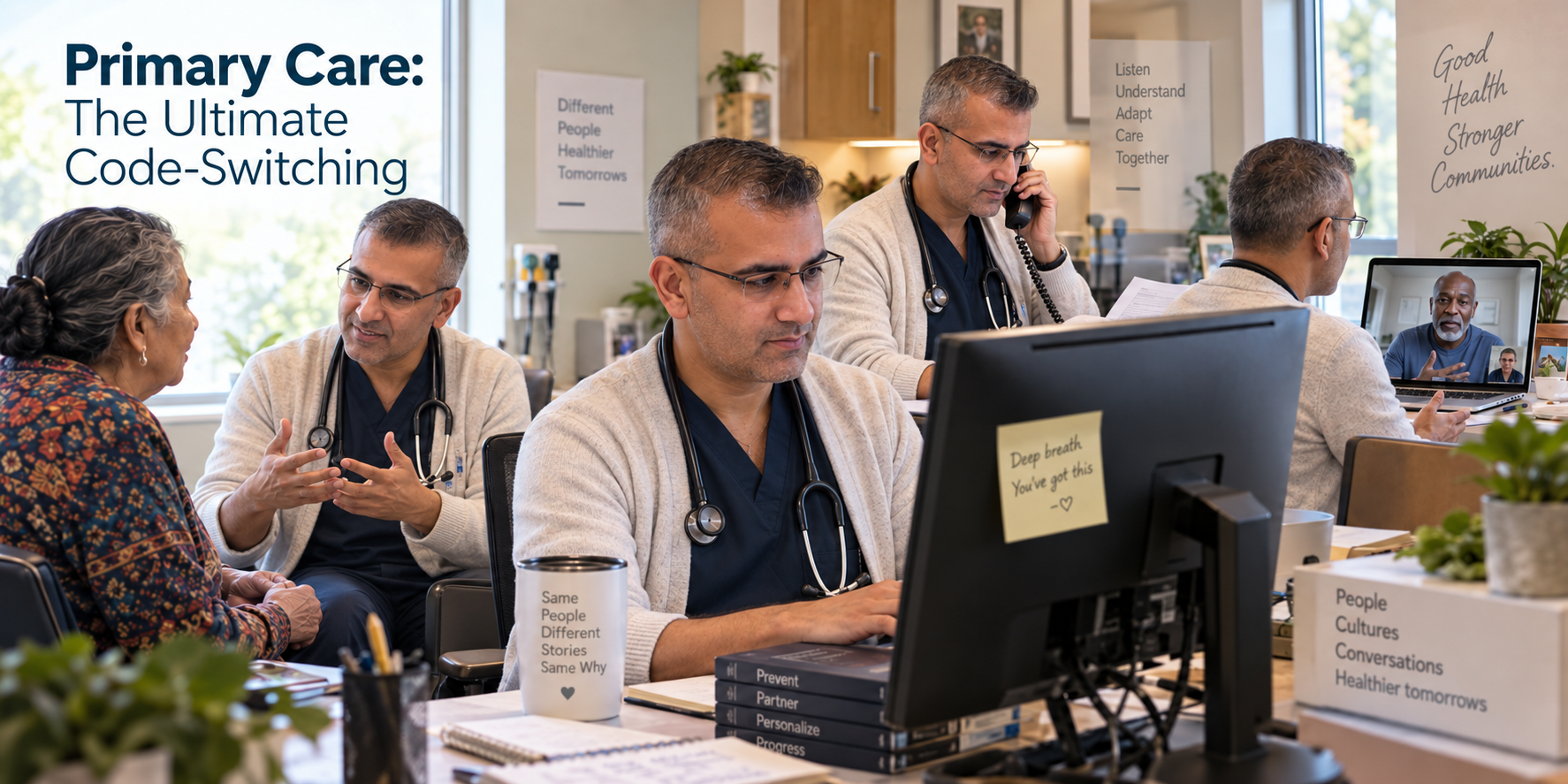
Code-switching is a hot topic, and while it is associated with strong cognitive abilities, it is also extremely exhausting. Many people do it intuitively, such as when switching between languages or accents. But there are also professions in which we are required to code-switch constantly.
Of all the medical fields, I think Primary Care may require the most code-switching. This is not to downplay any other field, but to understand what a Primary Care physician is actually required to do.
There are some specialties where you are focused more intensely on one thing. In Surgery or Anesthesia, for example, you have one person in front of you, and your sole goal is to take care of that person. You have other fields, such as Emergency Medicine or Hospital Medicine, where you have a dedicated panel of patients who are the only people you really care about at that moment (let’s be frank), and your goal is to take care of that particular panel.
But what about Primary Care?
In traditional models, when a Primary Care physician is responsible for 2,000 to 3,000 patients, you are constantly code-switching. Not only are you switching between the 20 to 30 patients you are seeing that day, but also between every lab result, every imaging study, and every patient message that crosses your screen.
You are constantly having to stop and think: “Wait, who was this again? What was their history? What condition made me order these labs?” Then, suddenly, you are interrupted by a team member with another question, an urgent patient triage call, or something else that immediately requires your attention.
I never fully appreciated the burden of this type of code-switching: constantly juggling hundreds of patients in your mind. With every new piece of information arriving in fragments, you have to synthesize it back into the patient’s larger story.
I thought Direct Primary Care would be different, but I have realized that this is probably part of the nature of Primary Care itself. In Direct Primary Care, we have a little more control over the volume. However, that does not change the fact that the amount of information may actually be greater because you have a more intense relationship with each patient.
You know more about them. And, frankly, you may have far more interactions with them through asynchronous communication because so much of that communication comes directly to you. As the physician, you may also be serving as the care coordinator, medical assistant, and everything in between. You are trying to connect all the pieces: what the specialist said, what is needed for a prior authorization, a new lab result that requires review, or an intensive workup you are trying to complete.
Add to that the experience of caring for an extremely diverse population. While this brings tremendous joy and richness to your patient panel and to your own life experience, it also requires you to shift your language, accent, vocabulary, perspective, and understanding of the cultural nuances that come with each interaction. Your body language may need to shift. Even the way you greet someone might be different.
And if you care for patients from cradle to grave, you must also shift between Adult Medicine, Pediatrics, and Geriatrics. The dynamic changes with each age group, each family, and each stage of life.
For a while, I thought there must be a solution to this. I have ultimately come to understand that it is simply part of the nature of Primary Care. Primary Care comes with incredible richness in terms of human relationships and dynamics, but it is also extremely mentally exhausting.
I thought Direct Primary Care would help alleviate this in some ways, and it does. But in other ways, it does not, especially given the volume of synchronous and asynchronous communication and the constant need to fit fragmented pieces of information back into the larger stories of the people whose lives have been entrusted to your care.