Five Cents vs. Forty-Five Million
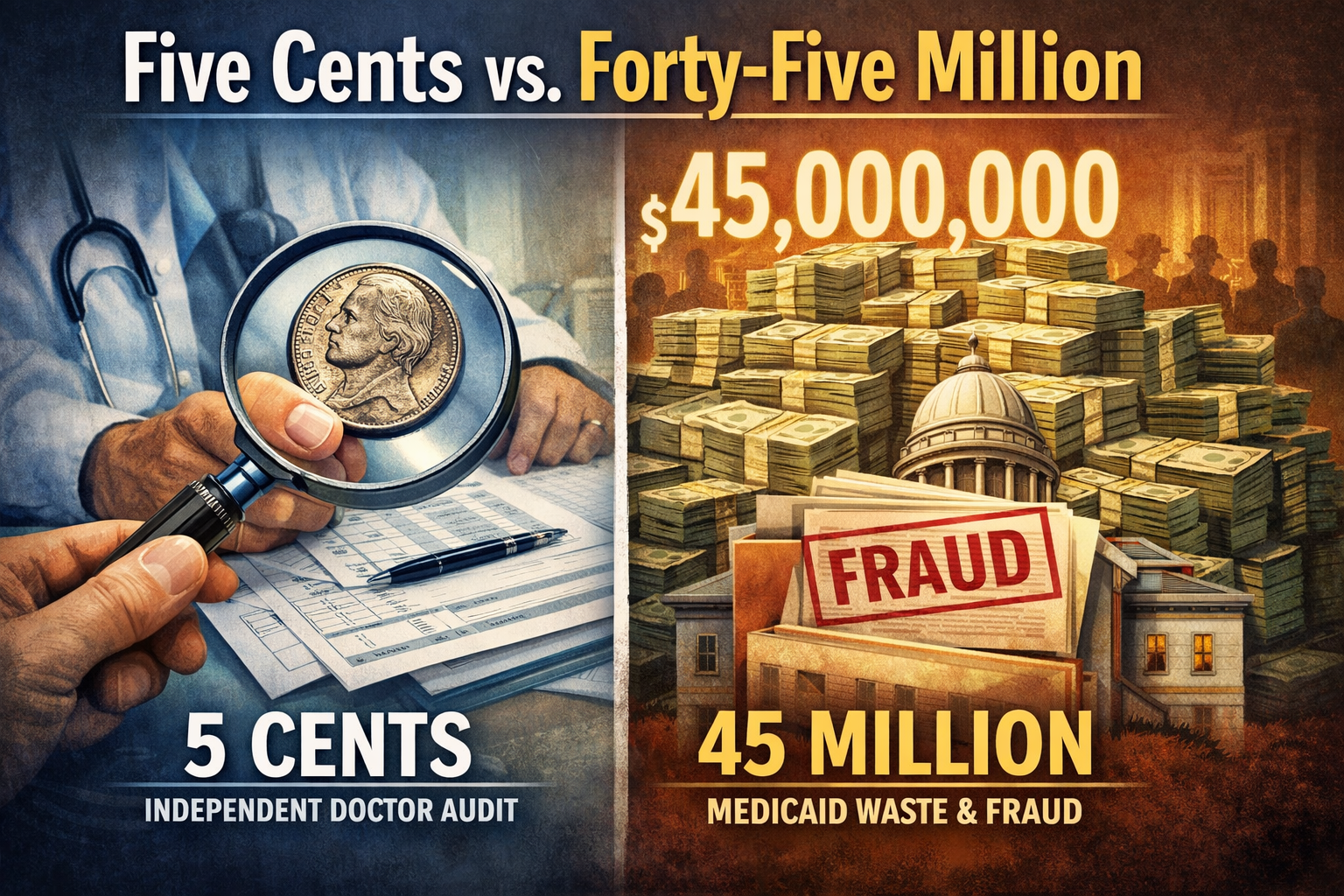
If you’re an independent physician in Maine and you miscode an office visit — say you bill a level four instead of a level three, a difference of maybe five bucks — you will hear about it. An auditor will find it. A letter will arrive. You will correct it, pay it back, and spend the next six months looking over your shoulder wondering what else they’re going to flag.
Now let’s talk about forty-five million dollars.
In January, the U.S. Department of Health and Human Services Office of Inspector General released an audit revealing that Maine made at least $45.6 million in improper Medicaid payments for rehabilitative and community support services provided to children diagnosed with autism. Not a typo. Forty-five point six million. And here’s the part that should make your coffee come back up: every single one of the 100 sampled enrollee-months had problems — payments for one or more claim lines that were improper or potentially improper. One hundred percent.
Maine’s Medicaid payments for these autism services ballooned from $52.2 million in 2019 to $80.6 million in 2023 — a 54% increase in four years. Missing documentation. Unsigned assessments. Session notes without descriptions of services provided or goals addressed. The federal government wants $28.7 million back.
Meanwhile, a Portland-based “provider” called Gateway Community Services has been flagged across three separate audits for overbilling MaineCare more than $1.7 million. The most recent review was initiated in January 2023. The state finally suspended their payments in December 2025 — citing a “credible allegation of fraud.” Three audits. Years of overbilling. And it took a credible fraud allegation to hit pause.
And then there’s Bright Future Healthier You, a Lewiston “provider” that was the largest biller of MaineCare for interpreter services over the past decade. Federal prosecutors charged three people connected to the company for billing for interpreter services that were never delivered. The kicker? It’s being prosecuted as tax fraud, not healthcare fraud.
This is what enforcement looks like in a $5.4 billion program. The program integrity unit recovers about $1.2 million a year — roughly 0.02% of total spending. It sends between three and five fraud referrals annually to the state’s Healthcare Crimes Unit — a ten-person team tasked with criminal prosecution across more than 5,000 “providers.” And when the Oversight Committee finally held hearings in February, the DHHS Commissioner’s response to questions about inadequate oversight was, and I’m paraphrasing only slightly: “I beg to differ.”
Now Let’s Talk About You
If you’re a solo doc or a small practice billing insurance — you already know what the enforcement environment looks like from your end. It looks like scrutiny. It looks like audits triggered by statistical outliers in your billing that exist because you actually spend time with your patients. It looks like documentation requirements that assume you’re guilty until your paperwork proves otherwise.
The system has unlimited appetite for policing small practices. An independent physician who bills outside the norm gets flagged. An independent physician who dispenses medications at cost gets side-eyed by pharmacy boards.
And if you’re a DPC physician who stepped outside the billing system entirely? You don’t even get the courtesy of an audit. You get something worse — you get cast as the evil incarnate of healthcare. The same system that can’t keep track of $45.6 million in improper payments will happily spend its energy telling legislators, hospital boards, and the public that your practice model is the threat to access and affordability.
But a “provider” that overbills $1.7 million across three audits? That gets a sternly worded letter and eventually — eventually — a payment suspension. A state program that makes $45.6 million in improper payments? That gets a committee hearing where elected officials and bureaucrats argue about whose fault it is while the money evaporates.
The Math Nobody Wants to Do
Here’s what the double standard really looks like in numbers. Maine’s program integrity unit recovers about $1.2 million per year. The OIG just found $45.6 million in improper payments in a single program area in a single year. That means the annual recovery effort amounts to roughly 2.6% of what one audit uncovered in one corner of the program.
But sure — let’s audit the family doc who billed an extra five dollars on a Tuesday.
The enforcement apparatus isn’t broken. It’s working exactly as designed. It’s designed to police the small and overlook the large. It’s designed to create the appearance of oversight without disrupting the institutions that generate the billing volume the system depends on. A solo physician is easy to audit, easy to fine, easy to make an example of. A hospital system or a large “provider” network is complicated, politically connected, and employs half the town.
What This Has to Do With Everything Else
If you’ve been following along — the closed referral networks, the specialist access barriers, the hospital systems that block independent physicians from referring patients — this is the same story wearing different clothes. The system protects its own. It enforces rules selectively. It punishes independence and rewards compliance.
The same state that can’t manage to police $45.6 million in improper Medicaid payments has no trouble making life difficult for the independent physician who stepped outside the system to practice medicine on their own terms. The message is consistent, even if it’s never stated out loud: stay in the system, play by our rules, feed our revenue cycle — and we’ll leave you alone. Step outside, and every line of your billing gets a magnifying glass.
Forty-five million dollars. One hundred percent of sampled enrollee-months with problems. Three audits and years of overbilling before anyone hit pause.
But tell me again about the five cents.
Sources:
- U.S. Department of Health and Human Services, Office of Inspector General. “Maine Made at Least $45.6 Million in Improper Fee-for-Service Medicaid Payments for Rehabilitative and Community Support Services Provided to Children Diagnosed With Autism.” Report No. A-01-24-00006. Issued January 16, 2026. https://oig.hhs.gov/reports/all/2026/maine-made-at-least-456-million-in-improper-fee-for-service-medicaid-payments-for-rehabilitative-and-community-support-services-provided-to-children-diagnosed-with-autism/
- Maine Public. “State referred embattled MaineCare provider for fraud investigation before halting payments.” January 23, 2026. https://www.mainepublic.org/politics/2026-01-23/state-referred-embattled-mainecare-provider-for-fraud-investigation-before-halting-payments
- The Maine Monitor. “Criminal case focuses on provider that billed MaineCare millions.” January 9, 2026. https://themainemonitor.org/criminal-case-immigrant-health-provider-mainecare/
- WGME. “Maine House Oversight Committee grills DHHS over improper Medicaid payments.” February 17, 2026. https://wgme.com/news/waste-watch/maine-house-oversight-committee-grills-dhhs-over-improper-medicaid-payments
- Maine Morning Star. “Amid mounting allegations, Maine lawmakers weigh next steps on Medicaid fraud.” January 23, 2026. https://mainemorningstar.com/2026/01/23/amid-mounting-allegations-maine-lawmakers-weigh-next-steps-on-medicaid-fraud/