What is a funnel (and what does one actually look like for a DPC practice)?
In med school and residency, nobody taught you how to market a practice. That was fine, because you likely were going to be an employed physician, and someone else handled marketing. But in Direct Primary Care (DPC), that someone is you.
So you start reading about marketing, and you run into a word that gets thrown around constantly: funnel. As in, “you need a funnel,” “build your funnel first,” “what does your funnel look like?” It sounds like a thing you’re supposed to already understand, and so most people just move on without actually knowing what it means.
Does that sound like you? Then read on, this post is for you.
What is a funnel?
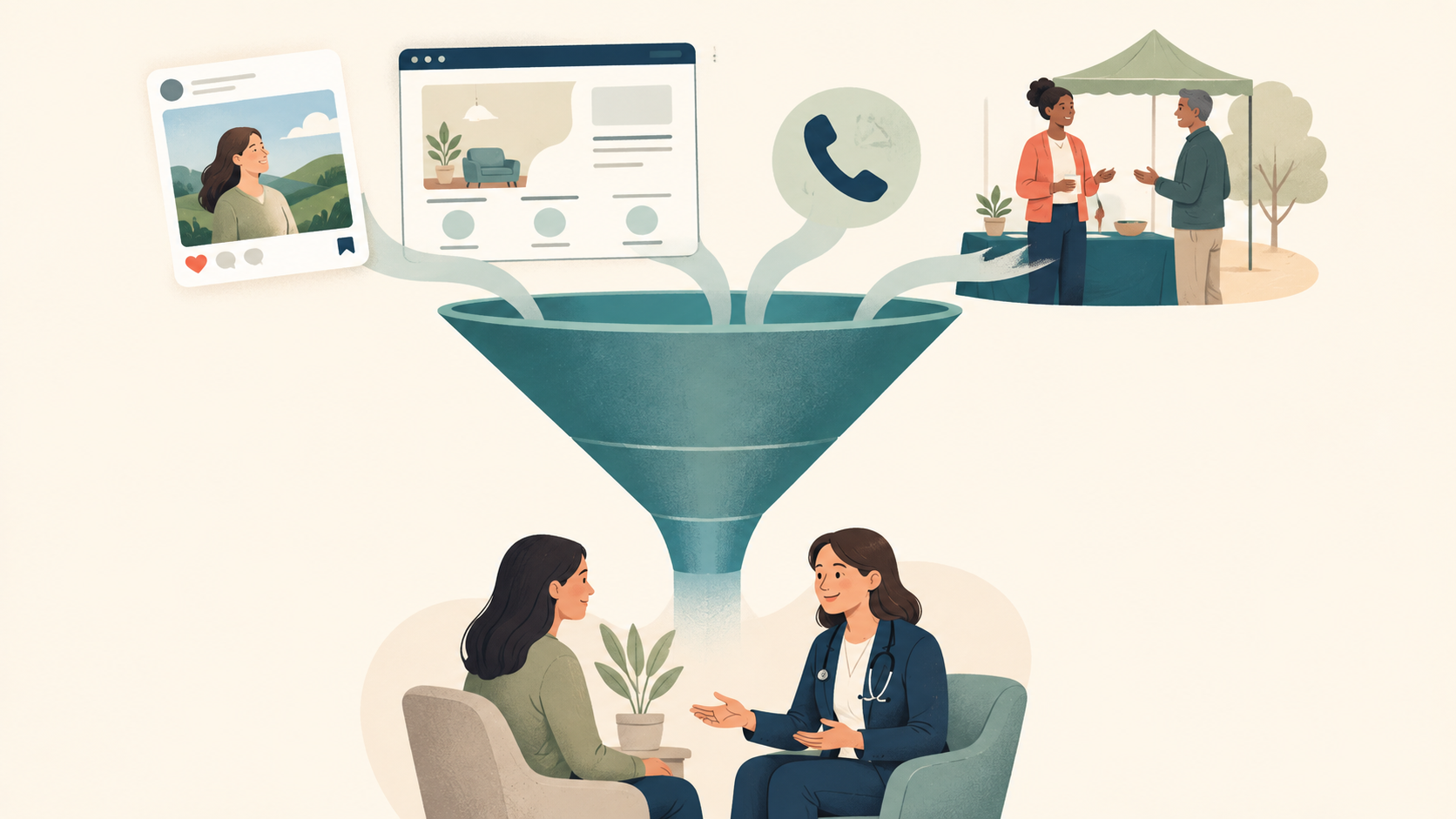
A funnel is just the path someone takes to become your patient.
That’s all. At the top of the funnel, people learn you exist. In the middle, they decide if they trust you enough to reach out. At the bottom, they sign up. The shape makes sense: many people hear about you, fewer look you up, fewer still reach out, and even fewer still join. That is normal. That’s how it works for every DPC practice.
In traditional medicine, this path was mostly invisible. Insurance panels and referrals brought patients to you. In DPC, you build the path yourself. That means you need to know what it looks like.
What’s in a basic funnel?
You don’t need anything fancy. A solo DPC physician building a practice needs three things: a way for people to find you, a way for them to learn more, and a way for them to take action.
A way for people to find you
People find you through a Google search, a social media post, a friend’s recommendation, or a local event. The channel isn’t as important as showing up in it with regularity. Pick one or two places and be there consistently.
For most DPC docs, this means a Google Business Profile so you show up in local searches, plus one social media account where you post often enough that something recent appears when someone looks. If you’ve been in your area for a while, word of mouth is already doing some of this. A funnel doesn’t replace word of mouth, it supports it.
A way for them to learn more
This is where most DPC practices have a gap. A potential patient hears your name, looks you up, and finds your website that says you’re “a board-certified physician committed to personalized care” and not much else. What does that even mean to them?
People in the middle of the funnel are trying to answer one question: what can DPC do for me? They want to know what they get as a DPC patient, how much DPC costs, how it works, who you see, and what it’s like to be your patient. A website that answers those questions plainly can do most of this work. A short video where people can hear you talk or a blog post with your name on it can help, too.
The goal here isn’t to impress anyone. It’s to give someone enough to know whether they want to reach out.
A way for them to take action
This is the bottom of the funnel, a “call to action” and it’s often the part that is forgotten. If someone is ready to ask a question or sign up, can they do it easily? Can they find your pricing without hunting? Can they reach you without leaving a voicemail during business hours and hoping for a callback?
At a minimum, put a contact form or a scheduling link on your website. Many DPC docs use a meet-and-greet booking link here. Meet-and-greets work well because it gets a curious person in front of you without asking them to commit to membership first. What doesn’t work is making the next step hard to find.
A way to follow up
This part also gets left out of funnel conversations, but it belongs here. Someone fills out your contact form or books a meet-and-greet. What happens next is still part of the funnel. Responding promptly, following up if you don’t hear back, and getting them to an actual conversation with you is all part of the funnel. The funnel doesn’t end when someone reaches out, it ends when they show up.
What a funnel cannot do
A funnel helps interested people reach you. It doesn’t do the work of becoming known and trusted in your community. Established DPC docs with full panels have almost always done the work of getting their name and face out in the community first. The funnel just made it easier for their people to take the next step.
If you’ve never mapped the path from “stranger” to “patient” in your practice, this is a good place to start. Look at each step. Find where people drop off. It’s usually clear once you look at it that way. Then try to make each step as easy as possible to move forward.
What you can build right now
Here’s a starting point that costs nothing except your time.
Set up a Google Business Profile if you don’t have one. Add your address or service area, your hours, your phone number, a few photos, and a plain description of what DPC is and who you see. This puts you in front of people who are already searching for a doctor near them.
Put up a website or a simple landing page, even if it’s not perfect yet. It needs your name, your location, a clear explanation of how your practice works, your pricing or a range, and a way to contact you. That is the minimum. Everything else can come later.
Pick one place to show up on a regular basis. This might be Instagram, Facebook, a neighborhood app, or a local newsletter, depending on where your patients spend time. Post there at least 4 or 5 times a month. It doesn’t have to be polished. It has to be honest and it has to be you.
Add one clear next step. Decide what you want someone to do when they’re ready to move forward: Book a meet-and-greet. Fill out a form. Send an email. Call the office. Put that one thing where they can find it. Don’t make them guess. Make it as easy and frictionless as possible.
Once someone reaches out, you respond the same day if you can. The faster the better, so you catch them when they’re most interested. That follow-up doesn’t have to be complicated. Answer their question, tell them what comes next, and invite them to a meet-and-greet. If they book one and don’t show up, reach back out with a phone call, an email, and/or a text. Some people just get busy. A quick message gives them an easy way back in.
Once these pieces are in place, they work in the background while you see patients. You’ll tweak things over time, but you’re not rebuilding from scratch every week. And once the basics are running, there’s a lot you can automate on top of them. That’s a different post. Start here first.