Bedtime Story for the DPC-Curious MD
When my grandmother passed away, I inherited a box of photographs that changed my life.
Up until then, I told myself that becoming a doctor took time, money, and energy I simply didn’t have. I tried to be a nurse, a med tech, then finally finished PA school, thinking it would be close enough.
Five years into my good-enough career, the box arrived.
My grandmother had chronicled my early years with devotion, but also with stunning emotional accuracy. Arranged on my coffee table, my truth was literally there in black and white. I had wanted to be a doctor since I could walk. I didn’t just put a stethoscope on my dolls and friends—I built hospitals for them, did rounds on them, and sat in my “consultation room,” chin in hand, while they told me their stories.
Then I did what anyone does when faced with a truth that changes everything.
I uttered a single expletive.
From that moment on, I knew medical school and residency couldn’t possibly be harder than continuing to fight myself.
I entered the blur: two years of prerequisites, four of medical school, and four of a combined Med/Peds residency. I was, without question, too old for the grind. But whenever I faltered, I opened my box of truth.
I love medicine, and I was willing to pay a dear price for it. But eventually the price became too dear for me to remain comfortable in the healthcare “industry.”
To me, medicine had become a sacred exchange that brought all the science behind it to life in service of the individual in front of me. I never found the ICD-10 code for that. And I came to believe that the person most qualified to define the value of my decisions was the one looking into my eyes.
I suppose that belief made my eventual path to Direct Primary Care inevitable.
Let me be clear: I was good at the game. I learned the language, adopted the codes, and satisfied the payors. I did this for years, thinking we were all very clever for beating the industry at its own game, while growing more disenchanted by the day.
Then one afternoon, while distracting a child so I could examine his ears, I was singing Itsy Bitsy Spider, changing the words with every line as I always did with kids to keep their attention.
Out tumbled:
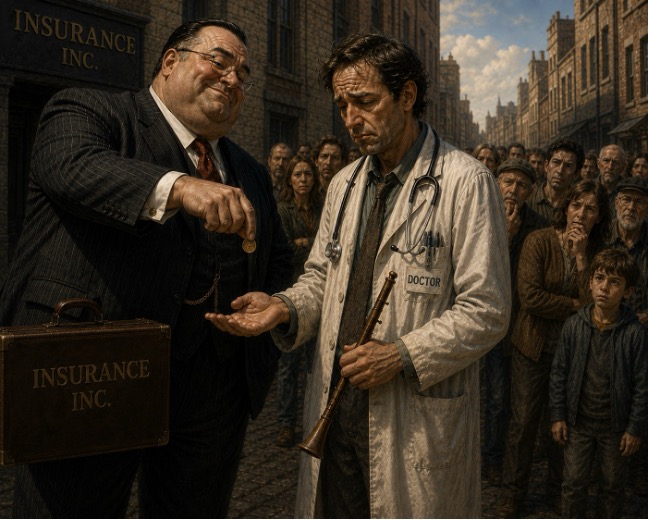
“He who pays the piper gets to call the tune!”
And suddenly its revolutionary meaning became undeniable to me.
If outside entities paid the tab, the tune no longer belonged to my patient or me. It was a business truth to which we had all slowly succumbed over decades. But eventually I realized it had become something more.
If a patient told me that someone else controlled their finances, socially isolated them through arbitrary demands, and regularly undermined their judgment and self-worth, I would diagnose a dangerously controlling relationship.
Something shifted when I realized how closely that described the working lives of many employed primary care physicians.
Eleven years ago, I translated those difficult discoveries into the only remedy I could find that would let me continue practicing the profession I truly loved and had already given most of my adult life to: Unorthodoc, a Direct Primary Care practice in Carrboro, North Carolina.
Operating without third-party constraint, I could give my patients the unconflicted doctor they deserved, along with safer, saner, cheaper, more accessible primary care.
And the relationships were different beyond measure when they began with:
“I choose YOU, Dr. Annis.”
instead of:
“You’re in my insurance network.”
I began to suspect that if my non-DPC colleagues knew how I felt when I drove to work each morning, they would jump into the getaway car and let me drive them to a safe house.
Maybe there wouldn’t be a primary care physician shortage if more of us were safe enough to remember who we are—and how it felt on the day we first knew we wanted to be doctors.
So this is my bedtime story for the DPC-curious physician.
There once was a doctor who spent years learning how to become one, and then many more years learning how not to lose herself after she did.
She found her way home.
If you are a primary care physician reading this and you just uttered that expletive of truth— welcome home.





Nailed it Cory! Well written.
This post speaks to my soul. I’m 8 years into my DPC practice and I agree – it’s a totally different world – in all the right ways! The lines that really got my attention include:
“To me, medicine had become a sacred exchange that brought all the science behind it to life in service of the individual in front of me. I never found the ICD-10 code for that. And I came to believe that the person most qualified to define the value of my decisions was the one looking into my eyes.”
“Operating without third-party constraint, I could give my patients the unconflicted doctor they deserved, along with safer, saner, cheaper, more accessible primary care. And the relationships were different beyond measure when they began with:
“I choose YOU, Dr. Annis.”
instead of:
“You’re in my insurance network.”
Thank you for this post. You have eloquently stated the essence of DIRECT Primary Care.
This is so beautiful 🤩 thank you