Direct Primary Care Statistics of the Week
I wanted to share some numbers from a recent survey and show how Direct Primary Care solves the issues. The article is called Why Have All the Doctors Gone? Insights Into Early Clinical Departure Among Physicians in the United States: A National Survey. This was the conclusion:
Among the 971 respondents included in the analysis, the majority (63.9%) identified as women, the mean age was 45.8 years, and 11.0% had never practiced after graduate medical education. The physicians who left practice reported “hassle factor” (44.7%) and “too stressful” (44.5%) as prime motivators for their departure. Physicians who were women were more likely than men to have exited due to needing to care for family members (7.9% vs 0.6%, P < .001) or children (21.3% vs 4.2%, P < .001). The mean age of physicians who left clinical practice was 48.1 years, 9 years younger than observed in a similar cohort in 2008.
Even better, here is the chart in the study:
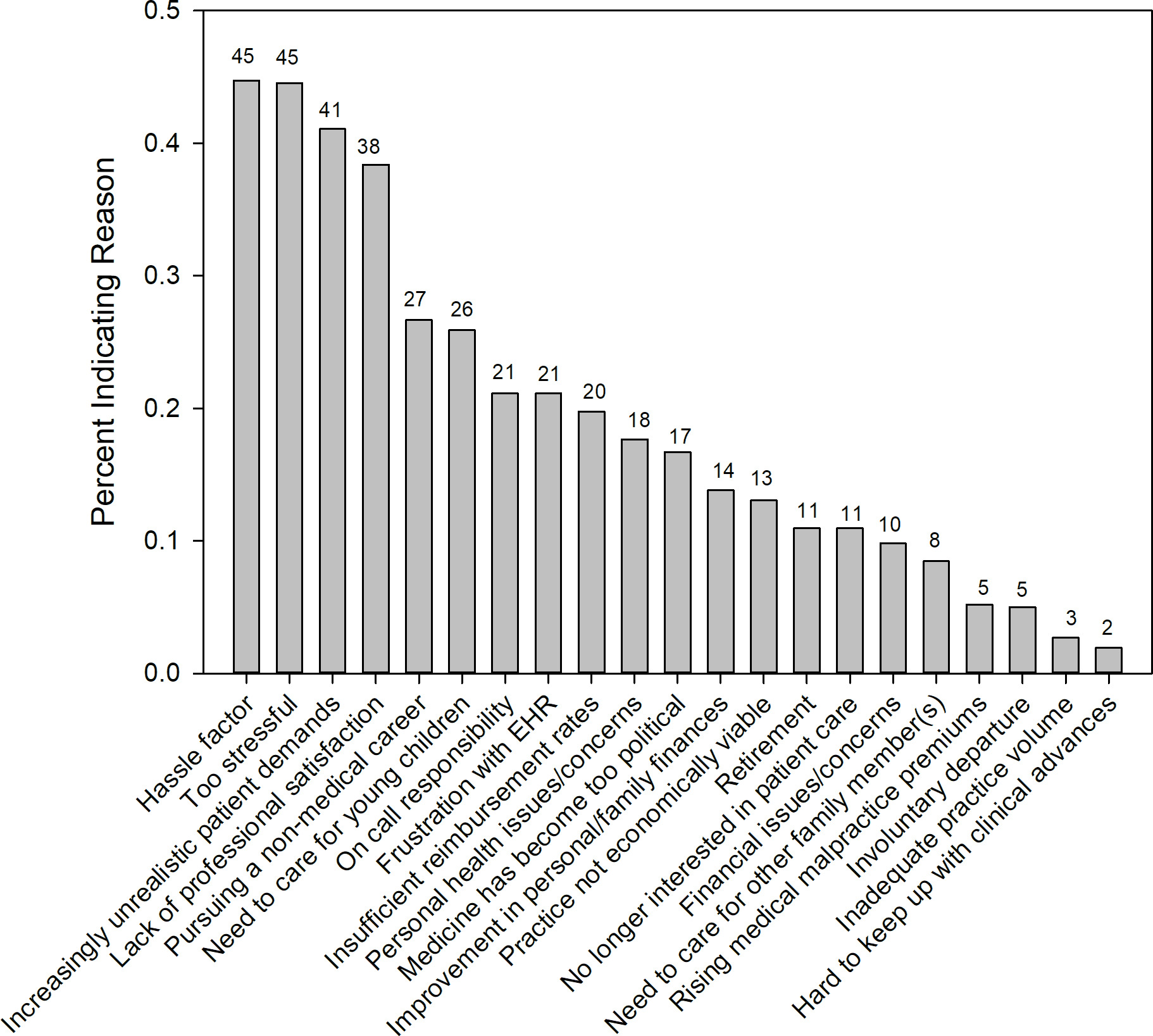
You can go through the full list and see how DPC can actually alleviate almost ALL of these issues. Hassle? Goes down. Stressful? Goes down. Patient demands, professional satisfaction, care for young children? All can be dealt with by doing DPC. But what do the authors think? Here are some of their thoughts:
- Although literature on interventions to reduce burnout has grown, the search continues for actionable solutions to the drivers of burnout.
- Normalizing the expectation that physicians take time away from work and implementing policies and procedures that eliminate barriers to taking the time away involves a cultural shift for which organizations can strive.
- In addition, organizations can build scheduling models that allow for flexible scheduling without penalties. Interventions to improve physician influence over their work environment (eg, flexible or customizable work schedules) can positively affect physician well-being, and enabling physicians to have more control over their schedules can make a big difference in physicians’ work–life balance.
- Ensuring physicians are equipped with the right job resources for patient care, have team support (eg, triaging patient requests), and have adequate time for managing messages can help mitigate stress associated with managing patient demands.
- Organizations that tap into this sense of purpose and meaningfully empower physicians with control over aspects of their patient care can improve the environment for physicians.
Yeah, they still don’t get it. Leaving the system that created the problem is the only hope for physicians to continue their careers instead of quitting, retiring, or doing something else. We should never listen to the same idiots who created the problem who now want to fix the problem.
Someday there may be an article that asks, “Where have all the doctors gone?” and hopefully the answer will be DIRECT CARE!!









Only deal is one needs to have a hospital with hospitalists that can take care of their admitted patients. In rural areas the doc is “the doc” that has to go to the hospital and care for them. For me I had a 5.5 year roundabout residency and could handle just about anything. I wasn’t stupid and knew when a patient needed to be transferred. Many of the specialists knew me when I was a student and understood I didn’t “dump” patients when calling. Only thing that was nerve wracking was when they agreed to a transfer but their hospital was filled. I’d silently panic but they’d tell me, “Call me and I’ll coach you. I’ll tell the next doc on call about the situation so they’ll know too.” I always got the patient out in decent shape and by the records they needed specialty care as they stayed 7 to 10 days or more in the referred hospital.