The Right Kind of Insurance
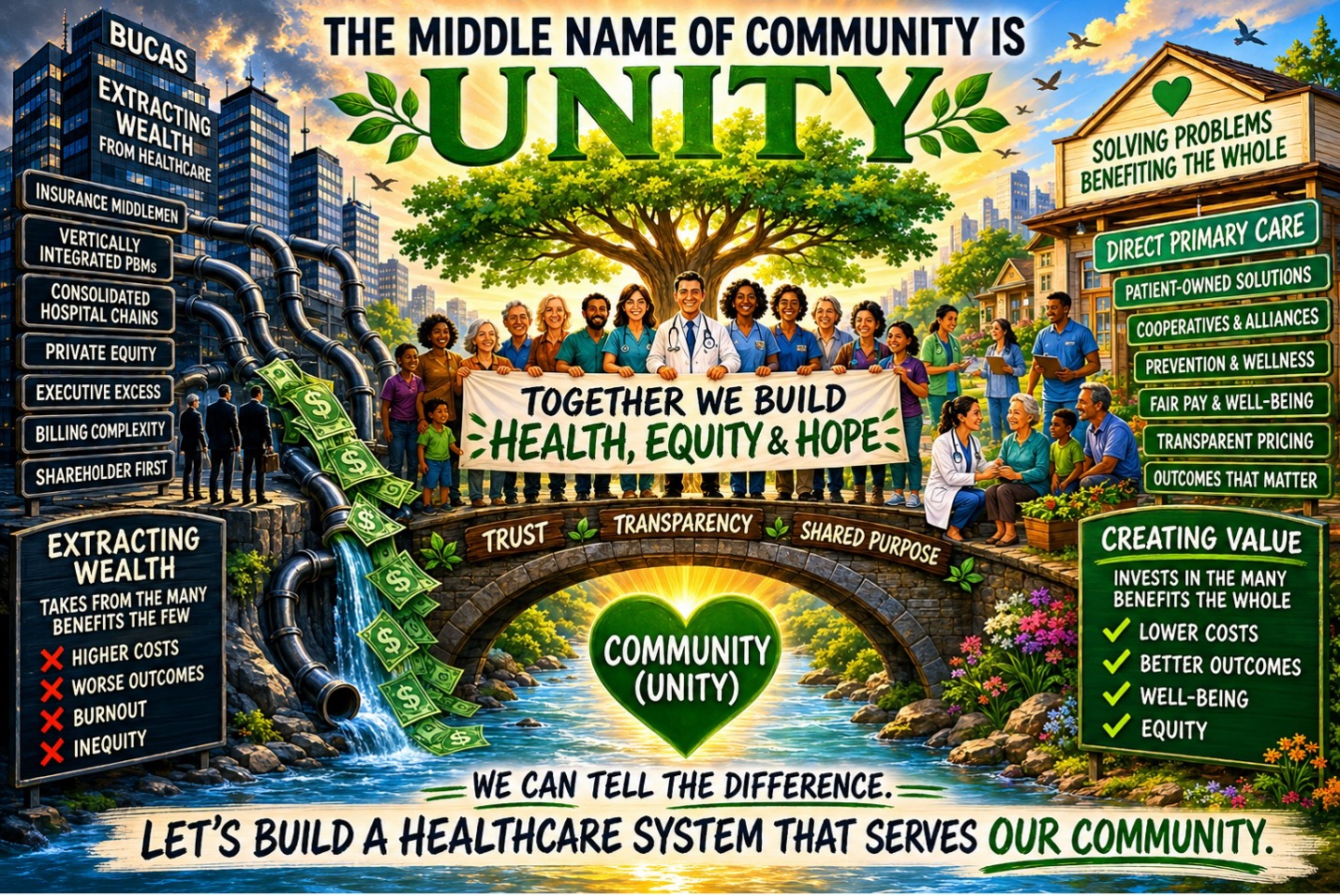
In healthcare, it’s easy to find a cause and become an activist. I understand that mindset well. When I stopped selling traditional insurance, it came with a strong rejection of the “bigs” in healthcare. But over time, I realized that simply opposing the system wasn’t enough. Building something better matters more.
There’s an important distinction between rejecting the BUCAs — Blue Cross, UnitedHealthcare, Cigna, and Aetna — and creating a new healthcare economy rooted in transparency, patient-centered care, fair pricing, and strong community partnerships. That new system still needs insurance, but it needs the right kind of insurance.
If you know me at all, you know I’m a passionate believer in Direct Primary Care (DPC). I truly love it. In 2020, I canceled my traditional health insurance and intentionally chose a health share so I could afford a DPC membership. Since then, I’ve happily lived outside the traditional insurance system.
That doesn’t mean I’m ignoring catastrophic risk. At the end of the day, everyone still needs a strategy for major medical events. For me, health sharing combined with DPC worked well as an individual solution. But for employer groups, self-funded and level-funded health plans are strategies worth serious consideration.
Most employers don’t realize they have more options than simply purchasing a fully insured plan from a BUCA carrier. In reality, large insurance companies also buy insurance for themselves. They use stop-loss insurance to protect against catastrophic claims.
The problem is that the stop-loss market is often vertically integrated into the same corporate structures that dominate traditional healthcare. That integration can create unnecessary costs and incentives that don’t always align with employers or patients.
Fortunately, employers can purchase independent stop-loss coverage from carriers that appreciate the value of Direct Primary Care and transparent healthcare models. That opens the door to building customized health plans that prioritize relationships, outcomes, and long-term sustainability.
However, employers shouldn’t rush into self-funding without the right guidance. A successful health plan requires thoughtful design and trusted partners.
Here are five important questions employers should ask when evaluating a high-performing health plan that supports DPC:
1. Does the stop-loss carrier support DPC?
Some stop-loss carriers recognize the value DPC brings through preventive care, better access, and reduced downstream costs. In some cases, they may even offer premium reductions or incentives that help employers contribute toward DPC memberships.
2. Is nurse navigation embedded into the plan?
Nurse navigation creates an important bridge between the physician, the patient, and the health plan.
Let’s face it — most DPC physicians don’t want to memorize every employer’s plan design details. Embedded nurse navigators help employees understand their benefits and next steps while allowing physicians to stay focused on practicing medicine.
3. Does the plan support preferred referral relationships?
One of the biggest advantages of a transparent health plan is the ability to build intentional referral networks.
Employers and physicians should be able to identify trusted specialists, imaging centers, surgery centers, and hospitals that provide quality care at fair prices. This helps establish upfront, agreed-upon pricing and makes direct-pay arrangements much easier when advanced care is needed.
Over time, these relationships can evolve into direct contracts that benefit employers, patients, and providers alike.
4. Does the plan use a fiduciary PBM?
Prescription drug pricing remains one of the most frustrating areas in healthcare.
The vertically integrated PBMs owned by the BUCAs are often criticized for rebate-driven pricing models, opaque contracts, and misaligned incentives. Employers need pharmacy partners that operate transparently and prioritize fiduciary responsibility over spread pricing and rebate maximization. When those partners are local, independent, community pharmacies, that is a “quadruple aim” winning equation.
When prescriptions are needed outside the DPC clinic, a fiduciary PBM can dramatically improve affordability and transparency while also steering employees to a community pharmacy where they can be cared for by a pharmacist who deserves an integral role on the local care team.
5. Does the data integrate with the DPC practice?
Employers need meaningful reporting that connects healthcare spending to outcomes.
When analytics and reporting systems integrate effectively with DPC practices, employers can finally see the return on investment many physicians already know exists. More importantly, the data helps demonstrate how direct-pay healthcare models can improve employee health while lowering long-term costs.
That level of transparency is exactly what many legacy healthcare organizations would prefer employers never discover.
Of course, self-funded plans are not the only option. Some employers are exploring ICHRAs — Individual Coverage Health Reimbursement Arrangements — as another pathway toward more flexible and consumer-driven healthcare strategies.
I’ll share more about those models in a future article.
Until then, stay healthy, y’all.






Disagree with this: “Employers need meaningful reporting that connects healthcare spending to outcomes.
When analytics and reporting systems integrate effectively with DPC practices, employers can finally see the return on investment many physicians already know exists. More importantly, the data helps demonstrate how direct-pay healthcare models can improve employee health while lowering long-term costs.” Sorry, no more metrics. That is why we left the system.
I would mention Dr. Lee Gross in this discussion. He may have some thoughts worth consideration. When he introduced DeSoto Memorial Hospital to benefits advisor, Carl Schuessler, and Carl’s Fair Cost Health Plan, mutually agreeable metrics were established. Those metrics were used to establish the benchmarks that Dr. Gross has been invited to many a stage to tell the DeSoto case study. This link will take you to just one of the stages he was on for that purpose — https://www.youtube.com/watch?v=E3zeShcqptI&t=3s. I invite the continued discussion.