Can AI Bring Back the Small Town Doctor?
The question deserves a real answer. It was just discussed on this popular podcast. And the people asking it aren’t wrong about the problem.
The thesis goes like this: AI-powered back-office tools are getting cheaper fast. Billing automation. Scheduling. Intake. Care coordination. The administrative machinery that once required a hospital system’s infrastructure could soon run on a small group’s budget. If that’s true, the economics of independent practice change. The small town doctor — the one who knew your name, your kids, your history — becomes viable again.
That’s not a stupid argument. The operational burden that drove independent doctors into hospital employment wasn’t a failure of nerve. Most ran the numbers and made a rational decision. If AI genuinely shifts those numbers, it matters.
But here’s where it goes wrong.
The back-office burden in primary care doesn’t exist in a vacuum. It exists because of insurance. Prior authorizations. Denial management. Coding compliance. Payer contracts. The entire apparatus of third-party billing is the disease. What these startups are building is a better way to manage the symptoms. A more efficient way to be sick.
You don’t bring back the small town doctor by making it cheaper to fight with insurance companies. You bring them back by eliminating the fight entirely.
That’s what Direct Primary Care does. Not cheaper administration. Not smarter billing software. Elimination. No insurance contracts. No prior authorizations. No revenue cycle to manage. Patients pay a simple monthly fee and get direct access to their doctor. Doctors practice medicine without a middleman taking notes on everything they do. The math isn’t complicated — it’s just rare, because the system spent four decades making independent practice feel impossible, and most doctors eventually believed it.
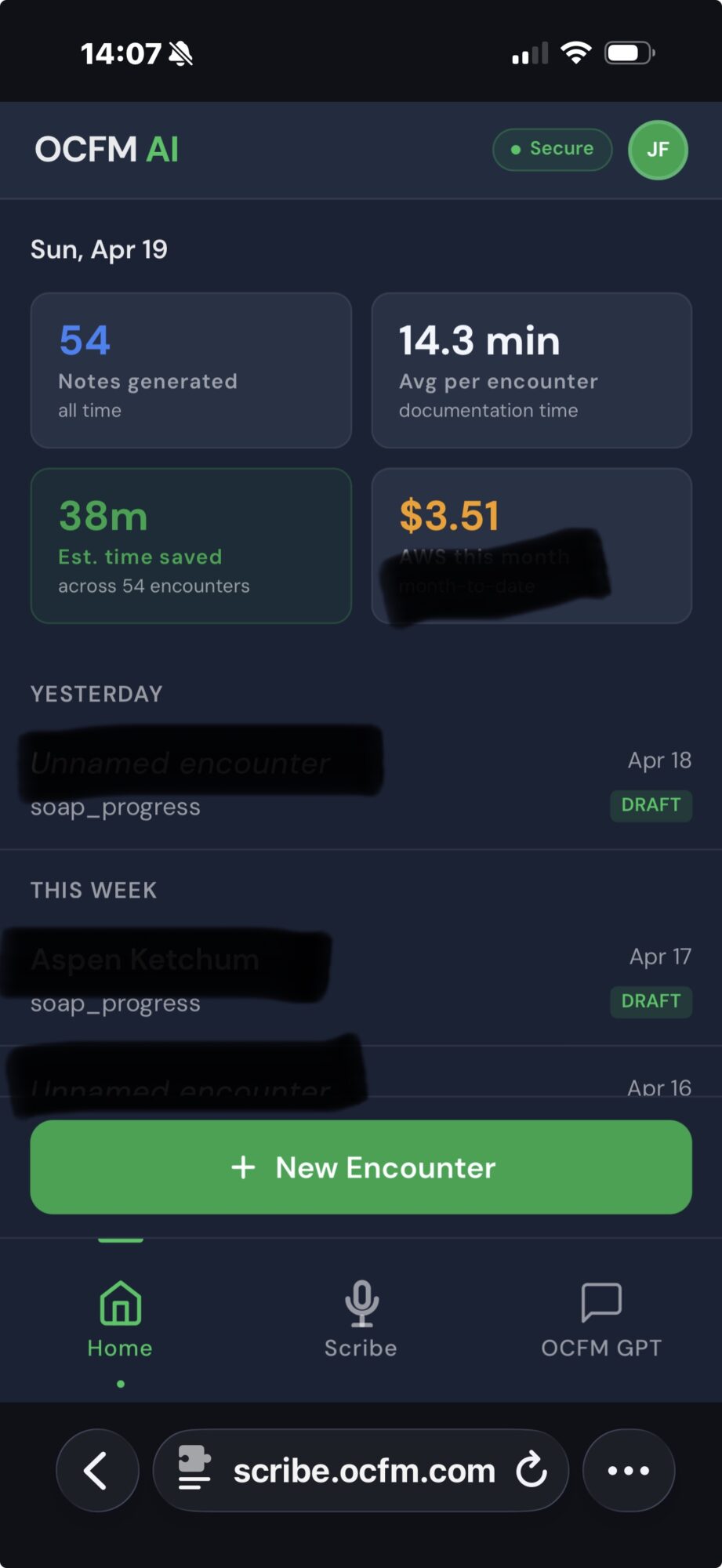
Here’s the irony I’m sitting with this Sunday afternoon: I built my own AI scribe and in-house GPT stack. Yes, you read that correctly. A rural DPC doctor in Maine built their own. I use it every single day. I’m a bigger AI enthusiast than most of the people writing breathless think pieces about it — and if you’re a physician who wants to know how, reach out.
My AI bill this month is $3.51. I checked.
But my AI isn’t fighting insurance. It never has to.
I won that fight in 2014 when I stopped billing insurance altogether. My AI does what AI should actually do in a primary care practice — it helps me take better care of patients:
– Documentation — referral letters, letters of medical necessity, and more
– Clinical decision support
– Real-time research with the patient in front of me
– Differential diagnosis support
– Plain-language patient education, generated on the spot
– Medication dosing and interaction checks
– Procedure guidance
The work that actually matters. It isn’t processing prior auth appeals or scrubbing claims for submission. Those problems don’t exist in my practice because I designed them out of existence before AI was even part of the conversation.
That’s the forest these startups keep missing. The small town doctor didn’t disappear because the field lacked billing software. Independent practice disappeared because the system made it financially irrational. Decades of declining reimbursement, administrative overhead, and payer complexity didn’t just raise costs — they changed what doctors believed was possible. AI that makes the irrational system slightly more tolerable is not the same thing as a solution. It’s a more comfortable form of the same trap.
I practice in rural Maine. My panel is over 1,200 patients, the majority of them uninsured — people who, under the old model, had no real access to a primary care doctor at all. I deliver babies. I do procedures. I dispense medications at wholesale cost directly from my office. None of this required a venture-backed startup, a sophisticated AI platform, or a health system’s administrative infrastructure.
It required getting out from under the model that was making all of it impossible in the first place.
AI can absolutely support independent primary care. In practices like mine, it already does. But not if you’re using it to prop up the billing apparatus that’s been strangling independent practice for decades. That’s not innovation. That’s rearranging the waiting room furniture while the building burns.
Direct Care brings back the small town doctor. AI, in that context, becomes a genuine force multiplier — because they finally have enough breathing room to actually use it.
I’m sitting at home on a Sunday afternoon — questioning why the Red Sox haven’t called me up yet — in a practice with 1,200 patients, no insurance contracts, and a homegrown AI stack. I didn’t need a venture-backed startup to get here.