Superbill: Benefit or Super Pain?
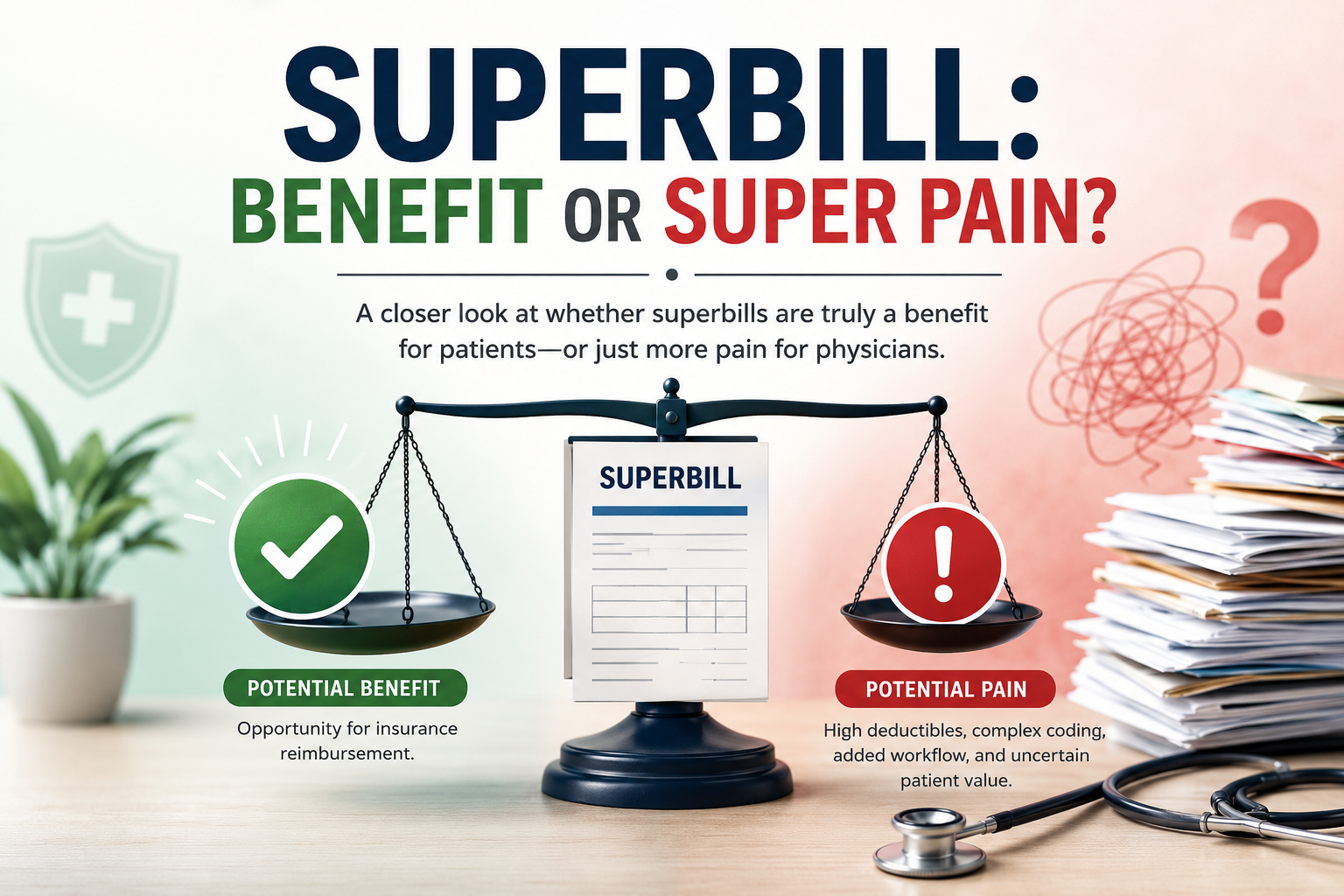
The direct-pay or cash-pay world is often an interesting space when trying to help patients understand why not using insurance may actually be beneficial. Yet many people remain tied to insurance, and one of the common ways practices attempt to bridge that gap is by offering superbills.
This has become an interesting point of discussion. Some practices routinely provide superbills, while others intentionally stay away from them. The question becomes: what real advantage does a superbill provide beyond marketing the idea that patients can seek reimbursement from insurance? When you begin to look at the details, that benefit does not always seem meaningful for the patient. The bigger question is whether the effort required—both from the patient and within the physician’s workflow—is actually worth it.
I recently reviewed a patient’s insurance benefits. Their in-network deductible was close to $4,000, with an in-network out-of-pocket maximum of approximately $8,000. Their out-of-network deductible was nearly $10,000, with an even higher out-of-network maximum. Situations like this highlight the importance of understanding your patient demographic and the types of insurance plans they carry.
In the direct primary care world, many patients choose high-deductible health plans to maintain HSA eligibility. If that is the case, they likely already have very high deductibles—and even higher out-of-network deductibles. This raises an important question: is a superbill even meaningful for these patients? In many cases, they would need to meet their out-of-network deductible before seeing any reimbursement from insurance at all.
From the physician side, providing superbills requires maintaining CPT codes for every visit, ensuring ICD-10 diagnoses are documented appropriately, and either manually generating superbills or investing in additional software to streamline the process. Many of us entered the direct care space specifically to move away from quantifying every encounter through billing codes or assigning a financial value to every interaction.
Adding superbills back into the workflow can create significantly more administrative burden for physicians without necessarily providing meaningful benefit to patients—particularly those with high-deductible plans or Medicare.
So the real question becomes whether advertising superbills as a benefit is truly worth it. You may ultimately find yourself creating substantially more work with little practical value to the patient, offering something that functions more as a marketing tool than a meaningful benefit.









I believe Lee Gross, MD said giving a superbill as a DPC doc has legal issues to it. Providing detailed coded Superbills (with CPT/ICD codes) can make the practice look like it’s participating in insurance-like activities. This may trigger insurance contract or “hold-harmless” issues if the patient tries to file. Also there could be audit/scrutiny from payers or regulators (e.g., if it resembles balance billing or improper claims support). It may even violate state insurance laws or federal rules around unlicensed insurance activity in some interpretations. So, I would NOT do it.
Don’t do it.