Why Telemedicine Is Not Direct Primary Care and May Be a Scam

Telemedicine is still trending as the new fad in medicine. There have been a lot of good things about it when it is used as an adjunct. In other words, when you are a real DPC doctor who has an established relationship with the patient then it may be very effective in a pinch. But the pandemic unleashed a new animal. Remember the old saying: never let a good crisis go to waste. When people were locked up in their homes and doctors were trying to limit the in-person visits to cut down on CV19 transmission, telemedicine was a great opportunity. I applaud that. What we are seeing now is different.
Big tech equals big money. Big money has a ton of power to lobby and influence legislation. This power corrupts medicine. One example would be Cerebral, a company giving out Adderall like Tic Tacs®. No one saw the patients in person. There were very few doctors involved.
How about Teladoc? Well, Teladoc lost $3 billion in the last three months. THREE BILLION!!!
Here is a new scam that telemedicine companies are trying to pull. Many of you may remember the Medicare fraud some orthopedic brace companies pulled. They would send letters to the elderly or advertise on TV that they can get free braces for their knee, back, etc. All they needed to do was fill out some information and the company would take care of the rest. The company would then fax the doctor hoping to trick him or her into agreeing to the coaxed prescription. Well, they are back and they are using telemedicine as a threat.
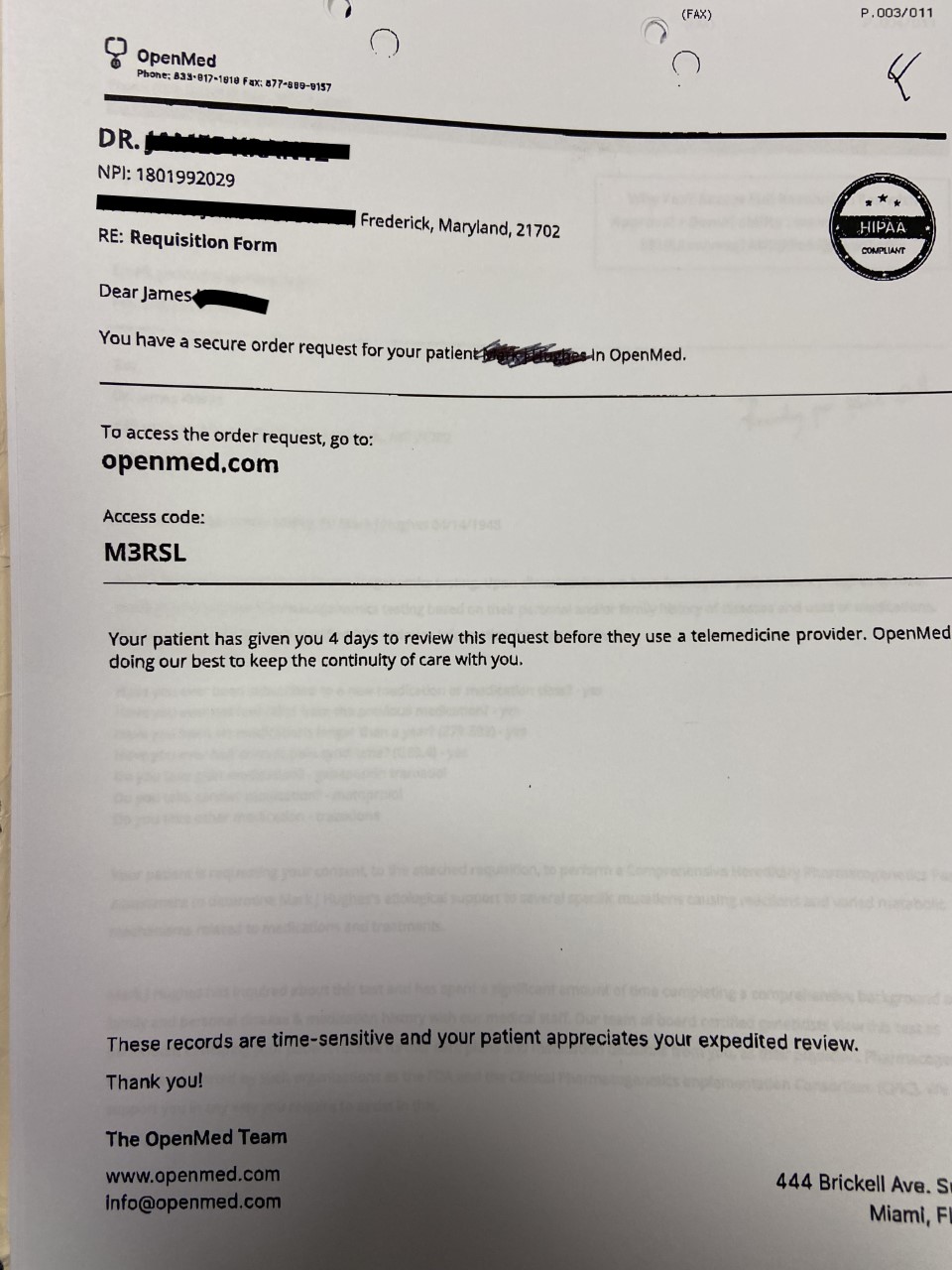
The above was sent to me by another doctor. I left most of it on there but the patient’s info has been scrubbed. How about the line that says “Your patient has given you 4 days to review this request before they use a telemedicine provider?”
This is extortion!!
And what was the request for? Here is what the doc told me:
This is an outfit who solicits patients to get “pharmacogenetic” testing, ostensibly to help the physicians choose drugs and doses–they usually focus on psych drugs. Many of us really don’t find it all that helpful or accurate and so the uptake among practicing physicians has been underwhelming. Lately, they have been marketing directly to Medicare patients and sending an “order” to their physician so they can milk Medicare for hundreds if not thousands. Of course, many doctors like me refuse to sign off on these things–they are a lot like the knee and back braces that the scammers try to get the Medicare crowd to get because, after all, it doesn’t cost the patients anything. The new twist is the threat to use a telemedicine “provider” who will happily sign off on the order if the physician refuses. I remain a refusenik.
Telemedicine has its place but it doesn’t REPLACE a real doctor who sees patients in person. I have seen the term “virtual” going around. One doc calls himself a “virtualist family doctor.” WTF is that? Another company says they do virtual direct primary care. Really? Virtual means:
Almost or nearly as described, but not completely or according to strict definition.
Exactly! Not the same.
I am putting this post out there for a few reasons. One, I want to warn you of the telemedicine scams coming your way. They need to be reported to the appropriate authorities for Medicare Fraud. Two, I wanted to also warn you of the telemedicine DPC DINOs who are coming to compete with you. Third, I want to keep putting posts out into the universe to reinforce the fact that telemedicine by itself is not a replacement for a real doctor. Just read anything about the observation ability of William Osler, MD.





I’ve had 2 Medicare patients tell me that they’ve been called by a company and told they qualify for cardiac genetic testing, and that Dr. Chapman just needs to sign the request so Medicare will pay for the test. They IMPLY, but do not directly say, that I ordered the test, and they are just waiting for me to dot the i’s and cross the t’s. They knew the patients’ diagnoses, their Medicare numbers, and that I was their doctor. One even used my clinic name in their phone call. One of my patients knew it was a scam and told me what was happening. She was getting calls from different scammed phone numbers telling her the same thing every day. When she tried to call the number back, she would get the message that the number she had called was not in service. Another patient wanted to know why I didn’t think she qualified for the test. I explained why, and that Medicare may not pay for the test, and the fact that the company wanted her to sign the ABN meant that she would be on the hook for payment if Medicare decided not to pay for the test. These tests are thousands of dollars. She eventually went to her “cardiac NP” who ordered the test. I’ve yet to hear whether Medicare paid for it or not, although the patient has been told she did not have the “abnormal cardiac gene”, and she was relieved to know it. Our tax dollars at work.
Un-believable!! I am going to use this as a post.