Why Direct Primary Care Isn’t the Problem—It’s the Path Back to Primary Care as a Common Good
A practicing DPC physician responds to misguided criticism and calls out the real villains
After seven years of practicing traditional primary care and nearly thirteen years running a Direct Primary Care (DPC) practice, I’ve witnessed both sides of the primary care crisis. Recent academic criticisms of DPC—written by authors who clearly lack firsthand knowledge of how DPC actually operates—portray this model as a selfish deviation from primary care’s mission as a “common good.”
What’s particularly galling is the callous disregard these critics show toward overworked, burned-out physicians, and the stunning hypocrisy of authors who have previously written about the destructive effects of value-based payment models on independent practices, yet now criticize the one practice model that’s actually sustainable for independent physicians.
Let me set the record straight—and call out the real threats to primary care as a common good.
The Academic Ivory Tower vs. Real-World Medicine
It’s rich hearing DPC criticized by academics who’ve never run a practice, never faced the soul-crushing reality of seeing 30-40 patients per day, and never had to choose between paying their staff or keeping their practice doors open. These critics demonstrate a fundamental misunderstanding of how DPC actually works, who it serves, and why it exists.
When I was seeing 30-40 patients per day in my traditional practice, spending more time on documentation than with patients, and fighting insurance companies for basic care approvals, I wasn’t providing good medicine. I was a caffeine-addicted, sleep-deprived automaton, barely remembering my reasons for pursuing medical school or even my family. The system had failed my patients long before I “abandoned” it.
But here’s what really infuriates me: these critics show callous indifference to physician suffering. They treat burned-out doctors as expendable cogs who should just grit their teeth and accept a broken system. That’s not just wrong—it’s cruel.
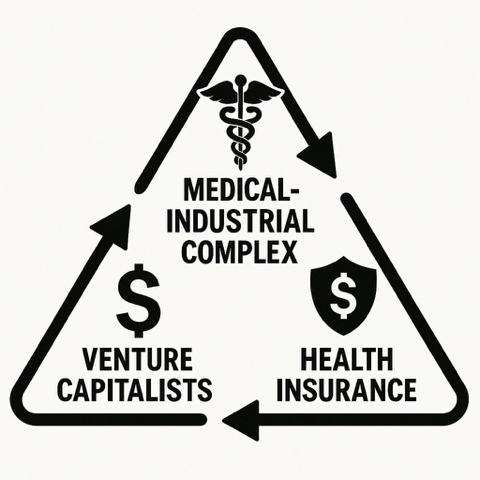
The Real Threats to Primary Care as a Common Good: Venture Capitalist Healthcare, the Administrative Medical Industrial Complex, and Out-of-Touch Academia
While academics wring their hands about DPC physicians “commodifying” healthcare, they’re ignoring the elephants in the room: venture capitalist-backed healthcare corporations that have turned medicine into a profit extraction machine, the increasingly bloated administrative medical industrial complex that suffocates actual patient care under layers of bureaucracy, and academia itself—so disconnected from real-world practice yet feeling entitled to dictate how medicine should be practiced.
These VC-backed entities have:
- Purchased independent practices and turned physicians into employees with productivity quotas
- Implemented electronic health records designed for billing optimization, not patient care
- Created administrative layers that consume 30-40% of healthcare dollars
- Imposed value-based payment models that reward documentation over actual care
- Transformed hospitals into profit centers that prioritize shareholder returns over patient outcomes
Meanwhile, the administrative medical industrial complex has become:
- Increasingly bloated with more administrators than actual healthcare providers
- Administrator-heavy organizations where executives outnumber physicians and nurses
- Systems that systematically undervalue physicians, nurses, and frontline healthcare professionals
- Corporate entities that have sold their souls to insurance companies for revenue streams
- Bureaucratic machines that prioritize metrics, compliance, and documentation over patient care
- Administrative empires that extract profits while forcing healthcare workers to do more with less
And academic medicine has devolved into:
- Ivory tower institutions completely disconnected from the daily realities of practicing medicine
- Research-focused academics who haven’t seen patients in years dictating practice standards
- Universities that prioritize grant funding and publications over practical healthcare solutions
- Academic “experts” who design payment models and policies they’ll never have to implement
- Institutions that provide residency training that doesn’t match reality, conducting research that doesn’t translate to practice
- Professors who criticize innovative practice models from the safety of their tenure-protected positions
That’s the real commodification of healthcare. And it’s being done by MBAs and private equity firms who’ve never touched a patient but are getting rich off physician labor and patient suffering.
The Stunning Hypocrisy of Academic Critics
What’s particularly galling is the blatant hypocrisy. Some of these same critics have previously written extensively about how value-based payment models and corporate consolidation are destroying independent primary care practices. Take the recent JAMA article “Value-Based Payment and Vanishing Small Independent Practices” by Rooke-Ley, Song, and Zhu, which documented how “the shift from fee-for-service to value-based payment models” is an “underappreciated” factor driving physician consolidation, with these models requiring “significant support and resources” that small independent practices can’t afford, ultimately making “independent practices a casualty in this era of payment reform.”
The authors correctly identified that “for small independent practices in particular, these payment models require significant support and resources” and “the pursuit of the capital investments, analytic tools, technology platforms, and regulatory expertise needed to enter value-based payment models risks further corporate alignment and consolidation.”
Yet now these same academic voices criticize DPC—the one model that’s actually enabling independent practice sustainability and growth? The cognitive dissonance is stunning.
DPC practices are among the fastest-growing segments of independent primary care precisely because they offer a sustainable alternative to corporate medicine. While other independent practices are being swallowed by health systems or going out of business—with an estimated 80% of physicians now employed by hospitals, health systems, and corporations—DPC practices are thriving and expanding as truly independent entities.
Using Physician Altruism Against Us
The most insidious part of the current system is how it weaponizes physician altruism. Healthcare corporations guilt trip doctors into accepting terrible working conditions by invoking our duty to patients and the “common good.” They’ve turned our medical oath into a tool of exploitation.
“You can’t abandon your patients,” they say, while systematically creating conditions that make good patient care impossible.
“You must serve the common good,” they insist, while extracting billions in profit from the healthcare system.
This emotional manipulation keeps physicians trapped in unsustainable situations while corporate executives get rich off our dedication and our patients’ suffering.
DPC: The Real Return to Primary Care as a Common Good
Here’s what critics miss: DPC is actually returning primary care to its roots as a common good—but without the corporate extraction and profit-maximizing interference.
In my DPC practice, I see 12-15 patients per day, spending 30-60 minutes with each patient. I know their families, their struggles, their goals. When they call with chest pain, they reach us directly—not an answering service, not a triage nurse reading from a script. My monthly membership fee is less than what most people spend on streaming services—the daily cost is less than a breakfast sandwich and coffee.
My patients include teachers, firefighters, police officers, pastors, plumbers, electricians and a variety of small business owners, not to mention retirees on fixed incomes. These aren’t wealthy elites—they’re working Americans who’ve been priced out of good healthcare by the corporate system critics are defending.
The Three-Tiered System Critics Won’t Acknowledge
When critics worry that DPC creates a “two-tiered system,” they’re describing something that already exists. We already have a three-tiered system where wealthy patients and government officials can navigate insurance bureaucracy, pay high deductibles, and access specialists; low-income individuals receive their medical care via subsidized taxpayer-supported coverage; and working families ration their medications and skip preventive care because they can’t afford copays.
DPC didn’t create this inequality—the corrupt, incestuous medical industrial complex and the venture capitalists did. We’re just making quality primary care accessible to people who were already priced out of good care by the corporate system.
The real “threat” of DPC isn’t that we’re creating a two-tiered system—it’s that we’re shining a bright light on the tiered system they created. And that makes them deeply uncomfortable.
Better Care, Better Outcomes, No Corporate Extraction
In my nearly 13 years of DPC practice, I’ve seen dramatic improvements in patient outcomes that were impossible in traditional practice. I’ve caught early cancers that would have been missed in 12-minute visits. I’ve helped patients avoid specialist referrals through thorough primary care. I’ve prevented hospitalizations through accessible, proactive management of chronic conditions.
My patients with diabetes have better A1C levels because we can spend time on lifestyle counseling and medication optimization. My patients with hypertension achieve better control because I can see them monthly without copay barriers. My patients with mental health concerns get integrated care instead of six-week waits for separate appointments.
This is what happens when you remove corporate profit extraction from the equation and let physicians actually practice medicine.
What We’ve Proven Works
Rather than criticizing DPC, academics should study what makes it successful:
- Smaller patient panels enable better care
- Direct physician-patient relationships improve outcomes
- Transparent pricing reduces costs
- Reduced administrative burden improves physician satisfaction
- Accessible primary care prevents expensive downstream costs
- Independent practices can be sustainable without corporate ownership
These aren’t revolutionary insights—they’re basic principles that traditional healthcare has abandoned in pursuit of corporate profits.
A Vision for True Primary Care as a Common Good
Imagine primary care freed from corporate profit extraction and bureaucratic interference. Physicians would have time to actually listen to patients, to think through complex problems, to provide comprehensive care that prevents rather than treats disease. Patients wouldn’t ration medications or skip preventive care because of cost barriers. Medical decisions would be made by physicians and patients—not insurance company algorithms or administrative protocols.
This isn’t utopian fantasy. It’s what happens in my DPC practice every day. When we remove the profit-extracting middlemen and bureaucratic overlords, medicine returns to its fundamental purpose: healing people. Primary care becomes what it was always meant to be—a doctor-patient relationship based on trust, knowledge, and mutual respect.
Calls to Action: Put Up or Shut Up
To the academic critics writing papers about DPC from your ivory towers: Stop theorizing and start experiencing.Spend a week shadowing me in my practice. See what happens when physicians have time to actually practice medicine. Talk to my patients about their experiences. Then write your critique—if you still have one.
To the policymakers and bureaucrats wringing your hands about the “commodification” of primary care: If you really care about the common good, support the models that actually work. Stop propping up the corporate systems that are destroying primary care and start removing the barriers that prevent sustainable independent practice.
To the healthcare administrators and executives extracting profits while physicians burn out: Get out of our way. Stop interfering with the doctor-patient relationship. Stop designing systems that prioritize your revenue over patient care. Medicine worked fine for thousands of years without your “help.”
To the insurance companies and venture capitalists: You are the problem, not the solution. Your profit-extraction schemes have turned healing into a commodity and physicians into data-entry clerks. DPC exists because of your failures, not despite them.
The Path Forward: Supporting True Healthcare Independence
I’m not arguing that DPC can solve all of primary care’s problems, but it’s demonstrably part of the solution. Instead of lamenting physicians’ exodus from corporate-controlled traditional practice, policymakers should ask why we left and support models that actually work.
The primary care crisis won’t be solved by guilting physicians into staying in exploitative systems. It will be solved by creating sustainable models—whether DPC, reformed traditional practice, or something entirely new—that prioritize patient care over corporate profits.
DPC represents a return to the true “common good” of primary care: physician-patient relationships based on trust, time, and medical expertise—not corporate profits, insurance bureaucracy, and administrative exploitation.
Until critics acknowledge that venture capitalist healthcare is the real threat to primary care as a common good, their attacks on DPC are not just misguided—they’re actively harmful to the physicians and patients they claim to defend.








Jack, this is SO good. I’d love to see this published as a rebuttal in every journal or paper that publishes these misguided and misinformed attacks on DPC that fail to see the REAL reason the U.S. healthcare system is a disaster. Thank you for all you do for your patients and for the movement as a whole 🙏
Jack, thank you for tackling the REAL problem in healthcare and showing the light on the likely only true solution.
Bravo! Really well thought-out and well written. I agree. This needs to be published everywhere. Local newspapers, journal rebuttals, national newspapers, and online news outlets.
feel free to share it with friends, family and enemies 😉
MIC. DROP. Jack, you are a rock star.
PREACH BROTHER JACK, PREACH !
I LOVE this post so much .
Excellent article Jack! Appreciate you taking the time to write this!
This is the BEST piece on DPC I have ever read! I would love for it to go viral, so that all Americans can better understand the issues with our current healthcare system and how DPC is the cornerstone of the solution.