When Did “Direct” Start Needing a Manager?
In the early years of my practice, I partnered with a few small businesses. One, around 2012 or 2013, was a natural food company with 50 employees. It felt like a huge win. The owner paid the memberships, a dozen new patients walked in the door in the first month, and nobody had to file a single claim. The same thing happened with several other local employers. Had I found the easy button to grow my practice?
Maybe, but I was always wary of putting too many eggs in one basket. So, as a solo practice, I intentionally avoided the larger employers. The majority of my patients were still individuals and families joining on their own, so day-to-day I didn’t think much about the difference between my members.
Then people changed jobs.
When an employee left one of those companies, they almost never stayed with NeuCare. It wasn’t because we did a bad job. In fact, most said something like, “You guys are the best doctor’s office ever, so I’m sad I have to leave you.” We tried to explain that they could actually keep me as their PCP. Alas, most of them were convinced their doctor came with the job, the same way their insurance card and other benefits did. They weren’t going to pay “extra.”
This situation wasn’t just part of the inevitable “churn” that happens in DPC. Without my noticing, the employer had quietly become part of the relationship. That was over a decade ago, but the lesson stuck with me. Even a friendly third party is still a third party.
What “direct” really means
Ask ten DPC doctors to define the model and you’ll get eleven answers. Most will mention the monthly membership, no insurance billing, and more time with patients. All true. But for me, the most important part has always been the first word in our name: direct.
A monthly fee doesn’t make a practice direct. If it did, DPC would be nothing new. Insurance companies and HMOs have paid primary care practices a flat per-member, permonth rate for decades. It’s called capitation,and it’s still around today. Nobody ever called those practices “direct,” and a third party can pay a monthly fee just as easily. The fee structure was never the point.
To me, direct means the arrangement is between the patient and the doctor. Not just the clinical decisions. The money, too. The patient decides who to see, pays them, and can walk away if it isn’t working. That last part keeps everyone honest, including me. I know that isn’t the legal or regulatory definition of DPC. Nobody at a state insurance department asked my opinion. But it’s what drew me to open my practice in 2011, and it’s why I’ve always thought of DPC as patient-centered by design, not by marketing.
Lately, a lot of our conversations center on physician autonomy and entrepreneurship. Those matter. They’re a big reason many of us took the leap. But the freedom that really makes DPC work belongs to the patient. When patients choose their own doctor and control the money, they start acting like owners of their health instead of passengers in someone else’s plan. That changes the economics, and it changes the psychology.
The new middlemen “helping” with employers
Our health care system is employer-based, like it or not. Most working Americans get their coverage through a job, so you’ll often hear some version of, “We must figure out how to partner with employers to grow DPC.” I understand the logic. But most HR and benefits teams have spent decades speaking the language of insurance and managed care: carriers, networks, contracts, renewals. That’s what they’re comfortable buying. So the next conclusion seems to follow naturally: DPC must fit into that paradigm.
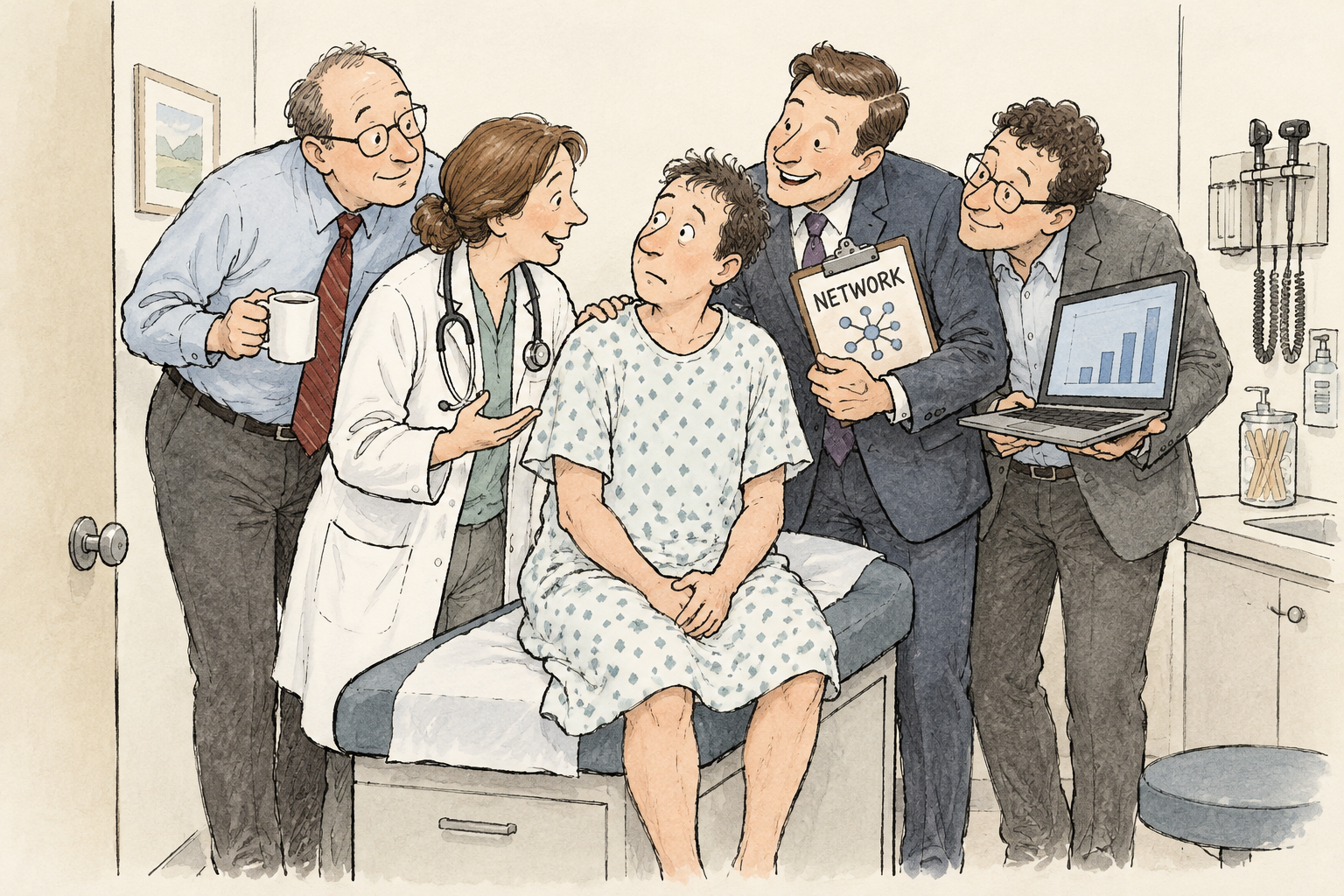
Today a new kind of company has moved into that employer layer. They contract with employers, recruit DPC practices into a “network,” and sell the package as a “Direct Primary Care” benefit. You’ll hear about “affiliate” practices and “DPC networks,” usually pitched as “we have some employers near you” by someone in an office a few states away.
Lately, most of them prefer to be called MSOs, management services organizations. That’s an awfully broad label. MSOs handle billing, staffing, IT, and a hundred other things.
Calling yourself an MSO is a bit like a casino calling itself a hospitality company. Technically true, but it leaves out the part that matters.
I’ve called these companies primary care management organizations, or PCMOs, because that’s what they actually do: manage the primary care dollars of a group of people. Some folks in the industry get upset when I use that term. I suspect it’s because the shoe fits.
To be fair, I understand the appeal for DPC practices desperate to grow. Selling memberships to individuals and families, or partnering with employers yourself, is often slow, painful work. A new practice staring at a half-empty schedule will take the call that promises a few hundred new members. When they say “we will pay $79 per month and bring you a lot of members,” it’s hard to say no.
Motives aside, I worry about where the structure leads.
Where this road goes
Picture a mid-sized metro ten years from now. A dozen of these MSO/PCMO companies are working with hundreds of employers. Each employer switches vendors every few years to chase a better rate. Each management company’s “DPC” network covers a different set of practices, and every contract will be renegotiated periodically.
Now picture being a patient in that market. You love your DPC doctor. Then your employer changes vendors, or you change employers, or your doctor drops a contract because the rate fell again. Congratulations, you have a new “direct” primary care physician. Nobody asked you.
That matters more than it might seem. Patients should always be free to leave a doctor and find a better fit. But making a real difference in someone’s health comes down to trust, and trust takes time to build. Our chaotic system has taught patients to be skeptical, bouncing them from doctor to doctor every time a job, a plan, or a network changes. DPC should do everything possible to make relationships that last years, even decades, the norm. That kind of trust can’t survive being reshuffled at each contract renewal.
Picture being the doctor, too. You’re in eleven networks, each with its own portal, metrics to report, and fee schedule. You’ve hired someone just to manage the contracts. Sound familiar? It should. It’s the managed care mess many of us left.
Then there’s the money. Every layer needs to get paid. Nobody builds a toll booth to wave cars through for free. No villains required. Intermediaries make their living in the space between the payer and the doctor, and once investors are involved, that space has a way of getting wider.
Last December I sketched this future in a tongue-in-cheek piece, The Rise of DPC (and its downfall), written as a news story from 2033. I meant it as satire, a warning about what could happen. Some days it reads more like a hurricane forecast.
A simpler idea
So what’s the alternative? I’ll admit it isn’t easy. But it is simple.
Give patients the money.
If an employer wants to support primary care, it can put a set amount into an account the employee controls and let them spend it on any DPC practice or direct-pay service they choose. No networks. No group contracts. No portals. If they change jobs, their doctor stays their doctor. If they’re unhappy, they leave, and the practice either earns them back or doesn’t. That’s a real open market, the kind DPC was built to compete in.
The same logic can work for public assistance dollars. I made a version of this argument back in 2017 with a proposal for personal health accounts, and I still believe it.
It isn’t much money, either. The average family health insurance premium cost employers and workers $28,303 this year, according to KFF, up 28% in five years. A DPC membership is paltry in comparison, and smaller still once you count deductibles and copays. We hand that absurd sum to management companies we call insurance without blinking. Yet suggesting patients control even 10% of that pie is treated as crazy talk. I think we can trust them with that slice to cover most common outpatient services. Given how things are going, is continue to hand 100% to the middlemen really the safer bet?
Will the folks who control those dollars today want to let go? Probably not. Brokers, insurers, and now PCMOs all have good reasons to keep the money flowing through them. But we don’t have to build our movement around their business models.
Keep it direct
I don’t blame anyone for wanting DPC to grow even faster. I want that too. But I’d rather grow a little slower and stay true to what we started than chase scale through a broken employer-based system. If the price of growth is quietly redefining the first word in our name, we’ll have expanded something. It just won’t be direct primary care.
I’m not writing this to be a contrarian or to pick a fight with anyone in our universe. I’m writing it because I love this model, and I care even more about the doctors and patients who desperately need it. I want to protect all three.
Call these management companies whatever you like. MSO, PCMO, networks. Just don’t call it direct unless the patient is the one holding the money.