The Primary Care Shortage: A Feature, Not a Bug
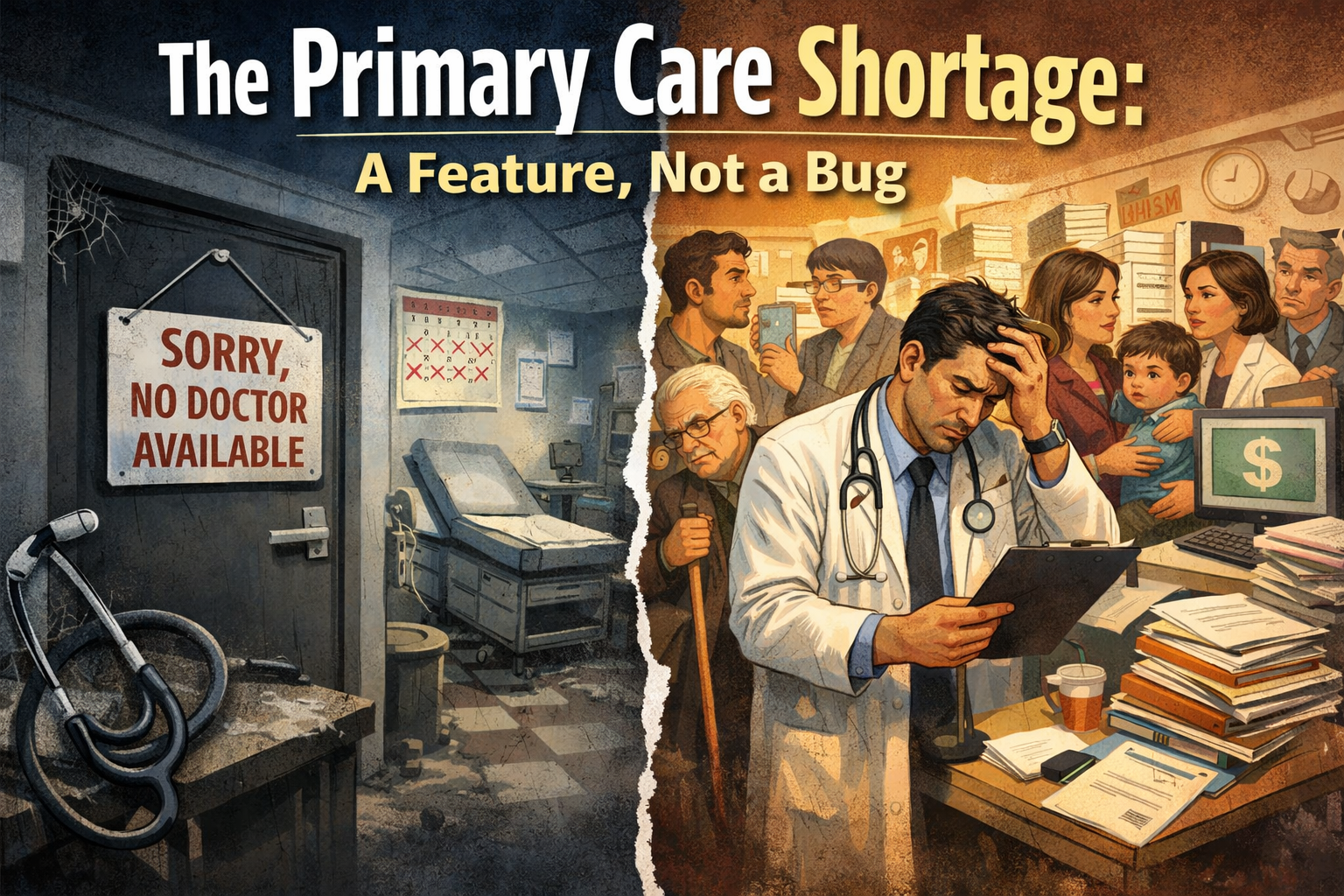
Doug Farrago, MD asked recently whether hospitals actually want patients to be healthy. Shane Purcell, MD has been sounding the alarm on the primary care death spiral. Both are right. Both are describing the same animal from different angles.
Here’s a third angle nobody’s named yet.
Maybe the primary care shortage isn’t a problem anyone is actually trying to solve.
Remarkable, really. Decades of awareness. Decades of concern. Decades of task forces. And yet here we are, with fewer primary care physicians per capita than we had a generation ago, a rural landscape where finding a family doctor feels like a minor archaeological achievement, and a healthcare system that responds to this crisis primarily by scheduling more hearings about it — in your state capital and Washington.
I want to be careful here. I’m not suggesting a conspiracy. No one gathered in a smoke-filled room — or a very nice conference room with a catered lunch — and decided America needed fewer primary care doctors. What I am suggesting is something more mundane and considerably more damning: the shortage is extraordinarily useful to a remarkable number of powerful institutions, and that usefulness goes largely unremarked upon. Possibly because the people doing the remarking are the ones finding it useful.
Consider who benefits.
Hospitals are the most obvious case. Every American without a primary care physician eventually needs care. They get it in the emergency department, where a basic lab panel that costs $35 in a DPC office costs over $1,000. They get admitted for conditions that would have been managed outpatient if someone had been managing them. Hospitals didn’t create the shortage. But if you asked them to fund a solution, you’d want to clear your afternoon.
Urgent care chains are more direct beneficiaries. The urgent care industry didn’t exist thirty years ago. It exists now because the shortage created a vacuum, and someone correctly identified that vacuum as a market opportunity. There are now more urgent care centers in the United States than McDonald’s locations. We are not celebrating this as a public health triumph. We should probably notice it isn’t an accident either.
Staffing agencies have constructed entire business empires on the reasonable assumption that the shortage will never be fixed. Locum tenens is a multi-billion dollar industry. The firms that place temporary physicians into perpetually understaffed hospitals have no meaningful financial interest in rural Maine suddenly producing an abundance of independent practitioners. Chronic scarcity is their product. You don’t sell water to people who just found a well.
Insurance companies benefit in ways that are less visible but worth naming. Fewer primary care physicians mean fewer referrals, fewer diagnostics, and fewer claims. The prior authorization apparatus — that towering monument to administrative friction — functions most efficiently when there aren’t enough physicians to contest every denial. A robust primary care workforce with actual time to advocate for patients is a considerably more expensive adversary. The current arrangement is much tidier.
Health systems that employ physicians may benefit most elegantly of all. The shortage is their leverage. When a graduating resident has six-figure debt, no realistic path to independent practice, and no other employer within driving distance, they take the terms offered. They sign the noncompete. They see the patients per hour required. They document in the approved manner. The shortage doesn’t just fill employed panels — it fills them on the employer’s terms, at the employer’s pace, with the employer’s metrics attached. It’s a remarkable negotiating position. One that evaporates if the shortage does.
And then there is the scope-of-practice argument, which deserves its own moment of appreciation. The entire legislative and regulatory push to expand what non-physicians can do independently rests on a single premise: there aren’t enough doctors. It is an argument that has opened doors, rewritten statutes, and reshaped entire professions. It also happens to be an argument that becomes considerably less compelling the moment the shortage is addressed. One might almost say it requires the shortage to survive. One might almost say that, and then stop, and look around the room.
Primary care physicians occupy a peculiar position in American healthcare. We are the only participants whose scarcity reliably increases the revenue of nearly every other participant in the system. Specialists bill more when patients arrive sicker and later. Hospitals fill more beds. Urgent care chains see more volume. Insurers operate against a population with less continuity of care and fewer physicians with time to appeal their decisions.
The incentives have been stable for a very long time. The shortage has been stable for a very long time. Perhaps this is a coincidence.
Direct Primary Care threatens this arrangement in ways that rarely get named in polite company. A DPC physician with a panel of 600-800 patients — seen longer, known better, reached more easily — delivers more functional primary care access than the same physician processing 2,500 patients in eight-minute increments. The model doesn’t just change how physicians are paid. It changes the math on access in a way that could, at scale, meaningfully reduce the shortage.
Which may explain why the institutions that have spent decades wringing their hands about the shortage have been so restrained in their enthusiasm for it.
None of this requires malice. Incentives don’t need malice. They just need to be incentives. And when the same structural incentives have produced the same outcome for thirty years, at some point the most parsimonious explanation is that the outcome is the point.
The primary care shortage is real. The suffering it causes — the missed diagnoses, the ER visits for things that should have been caught in an office, the rural communities with no physician at all — is real.
The question isn’t whether anyone wants to fix it.
The question is whether fixing it would be good for business.
Which brings us back to your state capital. And Washington. And the next hearing. The one where legislators, genuinely concerned about the shortage, will seek expert testimony on solutions. They will invite stakeholders. They will cast a wide net. They will hear from hospital systems, insurance carriers, large health networks, staffing organizations, and scope-of-practice advocates — every institution with a sophisticated government affairs operation, a polished spokesperson, and a deeply held organizational interest in the shortage remaining exactly as it is.
To be fair, they may also invite the independent primary care physician. The one actually solving the problem, one patient at a time, in a town nobody else will work in. The invitation will be genuine. The concern will be real.
The hearing will be held at 10 am on a Tuesday.









Laid out perfectly!