The Untold Story of a DPC Practice’s Birth
I’m going to make myself vulnerable here…
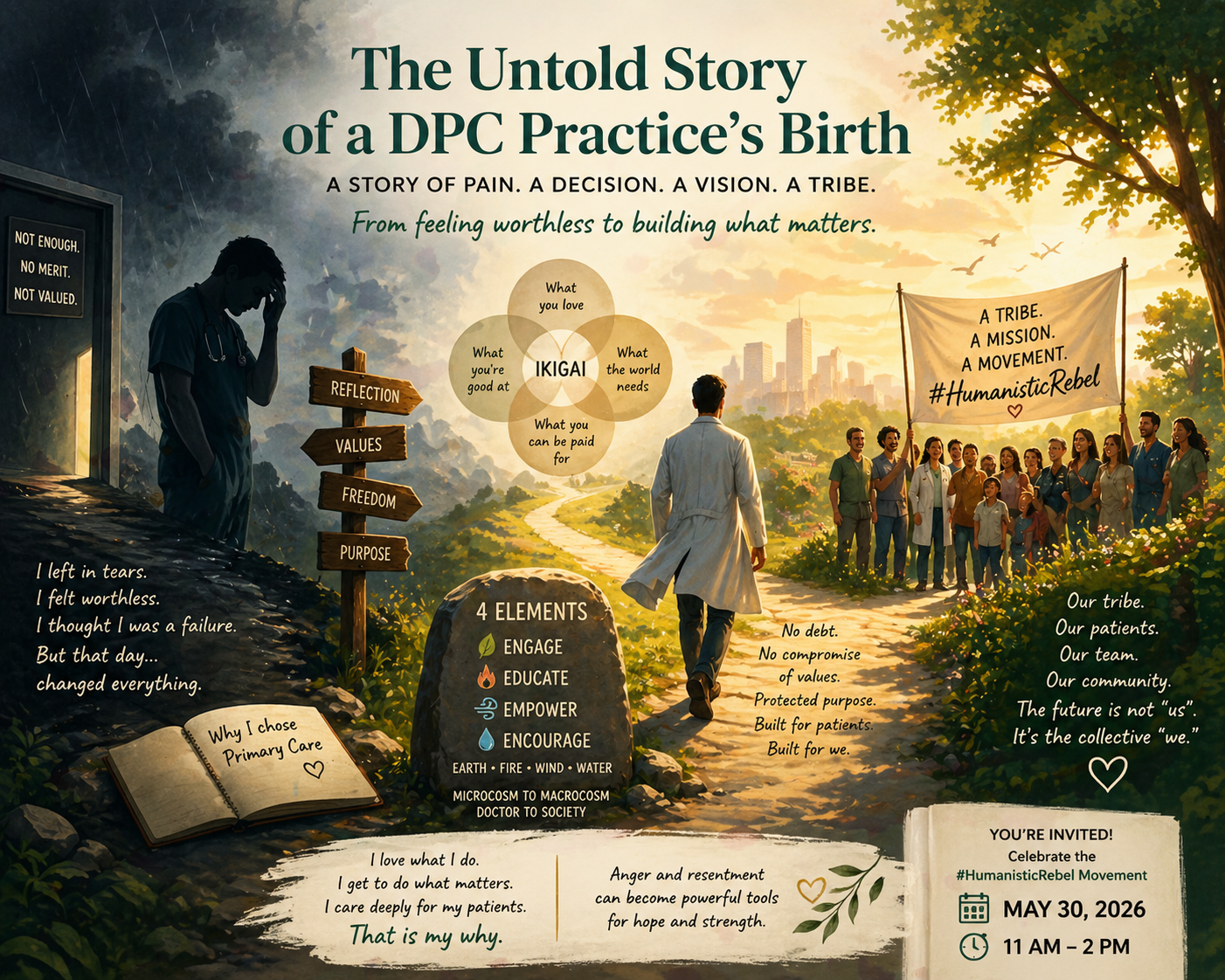
I remember that day very clearly—the day I decided I couldn’t do it anymore. I left the office and came home in tears. My “boss” had made me cry. I felt worthless. I had given everything I could, yet I was still made to feel, in front of everyone, that I had no merit. I had tried again and again to please the higher-ups… and I wasn’t the only one who had experienced this. But this time, I broke.
I came home, cried to my wife, and said I needed to quit my job. I had never felt before that I had to “quit.”
But I couldn’t wrap my head around it. I had led us through Joint Commission’s second survey with flying colors. I had initiated so many new projects. I had led us through DPH inspections with the same success. I had helped shape our culture and build a great team. So I knew I was a decent leader…
And I had helped build a clinic from scratch before. I had patients who cried and told me they missed me after I left. So I knew I couldn’t be that bad of a doctor…
So why did I feel like I was? Why did I feel, despite everything around me, that I was still a failure?
I submitted my resignation, and it was accepted without hesitation.
But here’s the interesting part… As the months passed, those who reported to me kept asking, “If leadership changed, would you stay?” It told me they valued me. And even more surprising—the same people who accepted my resignation without hesitation eventually began asking me to stay… some even discussing the possibility of higher leadership roles.
None of it made sense.
But one thing became clear: maybe I wasn’t as bad as I had been made to feel. I could do something. I was capable.
In that moment, I decided—for my core work, I would never work under a non-physician again. Why should a businessperson or administrator dictate how I practice? Why would I allow anyone to pressure me to lead or treat others in a way that didn’t align with my values?
I sat down to remember why I chose primary care.
I immediately thought of my time at Iora Health, where we launched a direct primary care-style practice for Hartford Healthcare employees. I remembered those relationships—what it felt like to care that way. I remembered texting patients back in 2015, before it was “a thing.” I had learned from brilliant leaders across the country, and while I felt small among them, it was a different kind of small—“I want to be like them,” not “I’m not enough.”
One of my former colleagues had asked me for years when I would start my own practice. She had followed me as a patient from my first role into the Iora practice, and then couldn’t continue with me when I stopped carrying my own panel.
That same summer, I reached out to a former patient who had become a pen pal. She had been diagnosed with “anxiety” around the time I saw her, but within days, we diagnosed a brain tumor, and she underwent surgery. After I left, she asked to stay in touch, and we continued writing.
When I reached out that summer, I heard from her daughter:
“Mom is on hospice, and she would love to see you.”
So I went.
We embraced and both burst into tears. She lay in a hospital bed, barely able to move. And in that moment, everything came together.
I sat with my wife, and we set a few rules:
I could not take on any debt
I might not contribute to the family finances, but I could not take away from them
We would no longer afford a nanny or extra help—so I had to be flexible while she carried more
Then came the question: what do we call this vision?
During my leadership training, I had developed a philosophy inspired by the transtheoretical model. That became 4 Elements—the four E’s:
Engage
Educate
Empower
Encourage
It also reflects Earth, Fire, Wind, and Water—a nod to Eastern and integrative philosophies.
It represents healthcare through four lenses: the microcosm (doctor and patient) and the macrocosm (system and society).
But most importantly, it represents my ikigai—where four things come together:
What you love
What the world needs
What you can be paid for
What you’re good at
I decided no corporation, administrator, or employer would ever control that part of me again. I may choose to do other work—but this part would be protected, guarded, and not for anyone to buy, threaten, or control.
What started as a solo mission became a tribe—and that’s what carries me through the hard times. A tribe of our families, our patients, our team, and our community.
Along this journey, our tribe has included many team members who have worn the banner of 4 Elements—some who are here, and some who have pursued further education and dreams, but all who will always be part of our family.
Thank you to Vibhav, Tien, Emanuel, Nidhi, Moshe, Jessica R, Sidra, Molly, Bableen, Phillip, Talia, Christina, Maria, Marisa, Deborah, Juhi, Paula, Ayesha, Akshata, Liz, Cynthia, Jill, Diana, Paul, Carolyn, Jessica, Anna, Melissa, Eliana, Prakash, and Hema.
This event is a celebration of that tribe and that idea. The future is not about “us”—it’s about the collective “we.”
Are we perfect? No.
Will I always feel like an impostor? Yes.
Am I scared all the time? Yes.
Do I know what I’m doing long-term? Heck no.
But here’s what I do know:
I love what I do.
I get to do what matters to me.
And I care deeply for my patients, respecting them and their beliefs—even when I disagree.
I am forever grateful for your support.
And as I think back to that day when I felt so worthless, I realize this:
Anger and resentment can become powerful tools for hope and strength.
I invite you to join us—and celebrate this #HumanisticRebel movement on May 30, 2026 from 11 AM to 2 PM.






This is a beautiful article! Thank you so much for posting this. Your writing is soulful, vulnerable and beautiful. It resonates so deeply and thank you again!