“Figure It Out”: An Overdue Reminder About Tech, Passion, and Not Being That Doctor
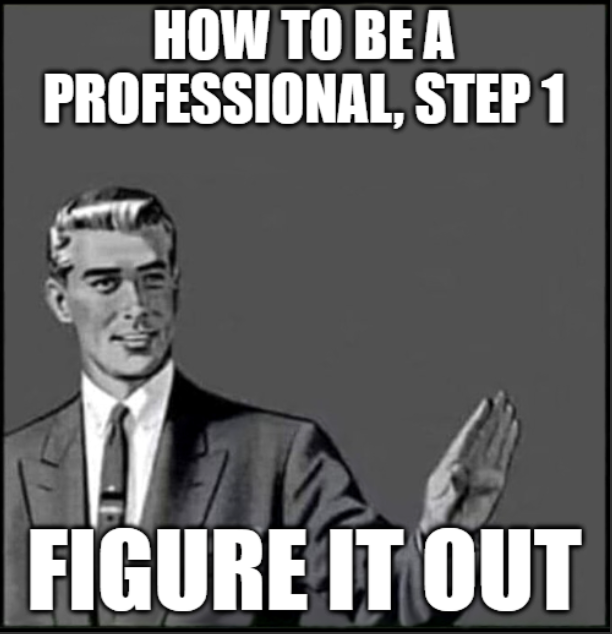
It’s been too long since I touched on the importance of continuous learning, not just learning medicine — new procedures, new workflows, expanding your value proposition, doing the work to be excellent rather than comfortable. This long overdue reminder has been on my back burner for a while now, and it was time.
I spend some time lurking in the online DPC physician forums. Although I chime in now and then on appropriate questions, most of the time I just groan and scroll. And I’m not alone. Many of the wisest OGs from the DPC world have long since abandoned various groups, resulting in a lack of institutional wisdom and the wisdom that can only come from experience because of this problem.
Here is the all-too-common pattern that genuinely bothers me and drives people away. It bothered me the first time I saw it. It bothered me the fiftieth time. Now I’m somewhere past tolerance and the “expressionless emoji”  and squarely into “Somebody has to say something! It might as well be me—let’s talk about this.”
I’m talking about help requests (usually tech, sometimes business-related) that should never, ever be made in a forum of highly educated professionals. From entrepreneurial physicians — people who survived undergraduate science programs, the MCAT, medical school, and residency—I see basic, foundational questions about technology and business that would embarrass a middle schooler. Not the tough stuff. Not complex EHR integration or API calls or backend coding or self-employment law or anything that requires real expertise. I mean the basics. How to use a scanner. How to use an EHR to send a referral. Workflow questions that a five-minute Google search would answer, if only the person asking had bothered to try first.
And here’s the salt in the wound:
These posts are frequently accompanied by some version of: “Ha, I’m just not a tech person!” or “I know, I know, I’m so bad at computers! Tee hee!” Like it’s endearing. Like it’s a humble, relatable, folksy quality to be proud of.
Well, it’s not.
Let me be direct: A “[giggle] I’m so bad at computers, can you 2,000 doctors in this forum please help me find the power button” post is not a humble brag. It is a problem, well within your power to solve.
Weaponized Incompetence
I’ve heard a term for this — “weaponized incompetence” — which refers to the practice of feigning helplessness to avoid doing something. And while I’m not suggesting every tech-impaired post in these forums is a calculated manipulation, I am suggesting the effect is the same: it transfers your work onto the shoulders of dozens — sometimes hundreds — of other physicians who have to stop what they’re doing to answer a question Google could have answered in 0.03 seconds.
PLEASE: Consider this for a moment: A post asking for help setting up a basic feature in an EHR that’s been on the market for a decade might get forty responses from forty DPC docs. That’s potentially hundreds of incredibly valuable hours of collective professional time, gone. Because someone decided their ignorance was a community problem rather than a personal one.
There are legitimate, hard questions that belong in those forums. Edge cases. Unusual clinical scenarios. Novel technical challenges where collective wisdom adds real value. That’s what those forums are for! But the basics? Come on man, figure it out!
I mean…am I out of line? Can I get an amen? Somebody please, please go to the comments and testify–as much as a jerk as I may be…please tell me I’m not wrong.
You Got Into Medical School — You Can Learn Your EHR
I have seen posts—and I am not making this up—from physicians who are hand-writing items, scanning them into the chart, and faxing them with a paper fax machine, etc. Or receiving a fax (on paper), scanning the paper into an EHR, then shredding the paper. You might as well just go start a forest fire and burn the trees down to cut out the middlemen. Handwriting. Scanning. Faxing. In 2026. I feel compelled to repeat that. This is 2026. THIS IS 2026. THIS IS THE YEAR TWO THOUSAND TWENTY-SIX. Just saying it out loud feels hyper-futuristic—a time millennia beyond fax machines.
To be clear: hand-writing, scanning and faxing are not inherently wrong if that’s your jam. It’s no more wrong than a guy making horseshoes on a mid-19th century forge to the delight of onlooking boomers at Dollywood. The difference is that the throwback blacksmith is not in an online forum asking a thousand cutting-edge Space-X rocket machinists how electric welding works.
An online lament about one’s inefficiencies from handwriting, scanning, and faxing in 2026 is like a person lighting a cigarette on an airplane in 2026. Reasonably normal in the ’80s; blatantly absurd today.
And it would be one thing if this were happening in secret, quietly, as an acknowledged embarrassment. An embarrassed offender lost in our world of microchips can and should find a colleague (or even a 12-year-old) to help them if they truly wish to operate a cutting edge DPC clinic with a reasonable value proposition. But it’s being posted about publicly, in professional forums, with that same cheerful “I’m just not a tech person!” energy, asking for help.
A quick aside while I’m on my soapbox. I feel the most pain for the tech support crews of the DPC EHRs out there. It’s not infrequent that I see these offenders blame the software for their inability to use it properly. I have an analogy for this (I know, big surprise): A horse person in 1943 reluctantly buys a car, and wants to use it to drive to the store, because apparently, the store now frowns on horses defecating out front. He takes driving lessons but refuses to learn how to use turn signals. “I don’t want to use that lever, I just want groceries!” he says, as if groceries have anything to do with turn signals. “This car is stupid-I shouldn’t have to move that lever to get some milk and bread. And why do people keep pulling in front of me when I turn?” Dude is insulting THE CAR. Riiiiight…the CAR is the problem. I have had staff members who, instead of learning a simple tech workflow, insult the technology that would make the job easy if they would only take a minute to learn it. Just as you might prefer one car to another, all cars are without question superior to walking 20 miles to work every day. (Obviously, Fords are a frequent exception here, but you get my point.) Likewise, a computer, AI, search engine, app, and EHR can and will improve your life if you humble yourself and put in the work to learn to use them correctly. But insulting the software as part of your request for help just makes YOU look bad.
I asked around the community for examples of this kind of behavior over the years, to give this rant a solid foundation, lest I just come off as a grumpy old man (which of course I am).
Some of these are paraphrases, but all are real questions/answers posed to hundreds or even thousands of doctors:
- “What is a PDF?”
- “Do I set up my own email?”
- [In answer to the question “Are you using Chrome or Firefox?”] “I think it’s Windows.”
- [In answer to “Are you using a Mac or a PC?”] “It says ‘Dell’ on it.”
- “How do I answer my phone when a patient calls?”
- “Do you take out your own trash?”
- “What do I do with outgoing mail?”
- “Where do you get cleaning supplies?”
- “What is a good kind of mop?”
- “How do I start an Amazon Business account?”
- “What should I do with cash?”
This is like the true stories of medicine we all have from our time in the often bizarre practice of medicine, you can’t make this stuff up.
I’m not saying these are necessarily dumb questions. I’m just saying these are the wrong places to ask those questions.
Whether you intend it to or not, asking these kinds of questions online speaks volumes about you and your character. They say, “I am not curious enough to learn the tools of my trade. I have decided the effort isn’t worth it. Because I am selfish and lazy, I value my own time over that of literally a thousand other doctors whom I have asked to spoon-feed me.”
I don’t know, maybe in the FFS system, you could get away with some degree of this incompetence. You had a coding department, an IT department, a biller, and seventeen other staff members to absorb your inefficiency. In DPC? You are the business. Your efficiency, your workflows, your tools — those are the engine. If your engine runs on 1987 technology because you never bothered to challenge yourself, that’s not a charming attribute. It’s a liability.
And consider the ironic effect of avoiding this work: It’s actually much more work! If you took the time to learn a workflow that eliminates all the antiquated behavior, the sum total of work subsequently prevented would save you hours—(nay, days!) of time to spend with your family — the very thing the worst offenders lament a lack of! Complaining and refusing to learn is akin to the guy who wouldn’t learn how to drive a car, so he just keeps riding his horse while complaining about how slow it is.
You got into medical school. You passed Step 1. You learned to interpret an EKG, manage a complicated delivery, and literally use a razor sharp knife to cut into another human being without killing them. Are you genuinely telling me that learning to use a search engine, AI, or your EHR to a minimal level of competence is beyond you? Or is it possible that it’s more accurate to say you just haven’t cared enough to do it?
Passion Is Giving a Crap
Excellence in DPC includes doing more than the bare minimum—in includes becoming shoulders others can stand on. That’s not just about medicine. It’s about the movement.
Growing up, we didn’t have money for fancy vacations. Ours were tent-camping trips to Colorado — which, for the record, were a spectacular blessing and in hindsight quite preferable to the costly alternative. But that’s beside the point. My dad had a rule I think he got from his childhood as a Boy Scout: you always leave a campsite cleaner than you found it. If you were primitive camping, you left the campsite as if no human had ever been there. No trace. Better, if anything. That principle has stuck with me across every facet of my life and career.
We have an obligation to leave this movement, the calling of medicine, and our patients — better than we found them. That means doing the work. It means being curious. It means rediscovering and holding onto our passion. Not shrugging off your technological ignorance as someone else’s problem when there are patients depending on you.
The culture of “not giving a crap” is popular—I keep seeing these vulgar social media posts, T-shirts, and coffee mugs bragging about being “Out of F#cks.” Pick a term for this: ironic detachment, performative helplessness, whatever. Spare me the indifference. Save that for the broken system, where the incentive structure actively punishes passion and quality while rewarding thoughtless, irrational, institutional compliance. Out here in DPC? Passion is the whole point. It’s what you sold yourself on. It’s what you told your patients justified the leap. Remember it and follow it, even into discomfort — especially into discomfort. Attempting to opt out when it becomes inconvenient nullifies your passion’s authenticity.
Humility Is Step One. Not the Finish Line.
Now — and this matters — I am not saying you should be ashamed that technology advances faster than you can keep pace with it. It does that to us all. I have areas where my ignorance is vast and humbling, and I won’t pretend otherwise.
Humility about what you don’t know is genuinely valuable. But humility is the starting line, not the finish line.
There’s a line from Batman Begins — Alfred asks Bruce Wayne: “Why do we fall?” The answer: “So we can learn to pick ourselves back up.”
For a person who’s career relies on applied intelligence, finding out you don’t know something should sting a little. That’s appropriate. That sting is useful information. It means: here is a gap between where I am and where I should be. The correct response to that sting is not to post about it in a Facebook group and wait for forty colleagues to fill in the gap for you. The correct response is to do something about it.
Google it. Read the EMRs, computers, or operating system’s help documentation. Watch a YouTube video! Search the group’s archives before asking; there’s a very high chance the question has already been asked. If you must, ask a colleague one-on-one, but try to answer your question on your own first. Spend an hour on a Saturday learning the tool that runs your practice. I recently saw a doc say he learned his EHR by CAFO (“Click Around and Find Out). Be a professional who is serious about their craft.
A Final Word
DPC docs are, on average, the most passionate, hardest-working, most entrepreneurial physicians I have ever known. I mean that. The community you have built in these online spaces is one of the greatest resources in medicine. The collective knowledge, generosity, and solidarity in those forums is remarkable.
Which is exactly why it should not be squandered on questions that have no business being there.
Be someone others can stand on. Leave the campsite cleaner than you found it. Pick yourself up. Figure it out.








Amen.
Agreed, EHR sucked and so glad I’ve been retired for 5 years. I WAS NOT computer illiterate either! Was a biochemistry major in undergrad and ran programs on early H-P minicomputers to do calculations and THEY did make life easier on me.
Only had 8K core memory too! Not 8mb but 8K! Could do a lot with that back in the day in the mid to late 70’s. When EHR came around later in my career, I saw though the administration touted it as “being great”, it was a piece of dung that would make my life miserable. Better to hire more transcriptionists to type out my dictated notes for me to sign later than spend all this freaking money on computers and pay more overhead for “software” rentals. Biggest thing to kill primary care medicine in my lifetime. Glad I was able to retire one year early than I planned and only had to suffer 4 years under this crap. Turning docs into secretaries is not the way to go. We didn’t train for this “chit” and the bastids who came up with this deserve to be condemned in the place where the devil lives. EHR has KILLED! primary care medicine.
Oh don’t get me wrong, I did like computers to look up labs not printed yet and view past hospital records but dealing with it for office patient documentation, it sucked to the N’th degree. I was a practicing M.D. and NOT a freaking secretary.
THAT IS WHY PRIMARY CARE IS IN A NOSE DIVE PERIOD!! Don’t know what they’re going to be able to do to save it.
I am too busy learning what my medical educators got wrong (statins, vaccines, opioids, nutrition, beta blockers, NSAIDs, hormones!!!) and course correcting to fret about tech.
Hi Molly! I’m busy with learning which half of med school was wrong too! One way I find time to learn about the buried statin studies is by efficiently operating my clinic. This required learning enough tech to create that free time through efficiency. Although, I might NEVER understand hormones… UGH I swear I’m trying. I think hormones are just magic/sorcery.
Amen indeed. FTSO