Match Day 2024: Empty Seats

Last week marked one of medicine’s great annual traditions- Match Day. Students from around the country and around the world found out if they matched into a US residency and then, later in the week, where they matched. The National Residency Matching Program (NRMP) facilitated the Match process and routinely collects data on all the students which allows for examination of trends and comparisons. Consistent with the last several years, primary care specialties, especially family medicine and, more sharply this year, pediatrics continue a steady decline in interest.
The AAFP publishes a press report on Match Day each year celebrating matches in family medicine. In the midst of a pipeline crisis in family medicine, the reports read like delusional propaganda. This year is no different.
Here are some of the figures they celebrate:
- Increase of 65 in total number matched (before SOAP/Scramble)
- Increase of 124 in total number of family medicine spots offered
Already, there’s an obvious issue. Number of spots offered rose almost double the increase in spots filled. State and federal efforts to solve the primary care shortage have focused on increasing the number of primary care spots available. However, as illustrated by these first two numbers, increasing the number of something doesn’t make it more valuable. Basic Econ 101 teaches supply and demand to determine price or value. Increasing the supply of something with low demand (family medicine positions) will only devalue the thing more. Looking at the breakdown of US MD/DO and IMG match rate further illustrates the principle.
- US MD match increased by 36 from last year: 1,499 → 1,535
- US DO match decreased by 21: 1,514 → 1,493
- IMG (US citizens and non US citizens) match increased by 100: 1,355 → 1,455
US MD match slightly rebounding from the all-time low seems like a small silver lining, but still falls short by 20 compared to 2022. US DOs kept match numbers looking acceptable from 2018-2020 when there was a sharp increase in DO FM matches. Of course, this was during the merging of the MD/DO match, so the increase likely represents a change in reporting rather than an actual change in match trend. A drop in DOs matching into FM represents a reversal of the previous decade of growth; a fact made more concerning by the fact that the drop comes in the setting of an increase of 623 new DO applicants in the match compared to last year. The rapid rise in IMG participation is driven by a surge in foreign IMG participation as there was even a decrease in US IMG matches this year. Should the current trend continue, students trained outside the US could surpass US MD and/or US DO students in the FM match.
A picture is worth a thousand words, so here is the AAFPs graph they published with this year’s celebratory piece. Looking at the graph, there doesn’t seem much to celebrate.
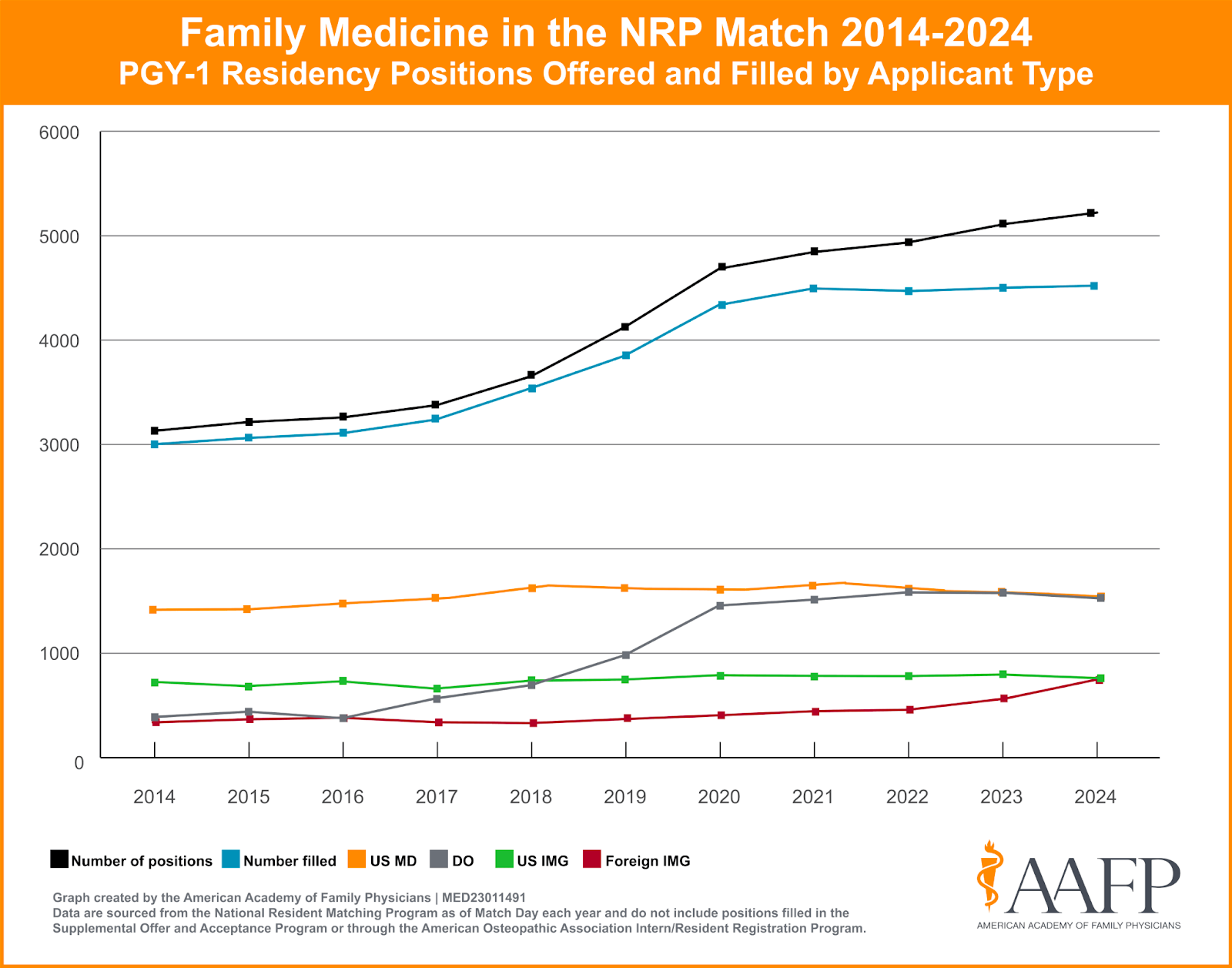
Note the growing gap between available spots and spots filled.
Pediatrics suffered a similarly rough match this year and the AAP produced a more honest press release detailing their numbers. Like family medicine, pediatrics keeps increasing the number of spots offered from 2,864 in 2020 to 3,139 this year. They had an increasing number of filled spots over the same time period until this year where the total number only dropped by 13, but with the increase in available spots, the percentage of positions filled decreased from 97% to 92%. US MD match decreased by 7% to 47.6% of those who matched into pediatrics, which still beats out the 33.4% of those matched into FM.
Dr. Brian Carmody, a pediatric nephrologist publishes an annual Winners and Losers report. His work is consistently thorough and spot on, including this year’s report which includes this graphic showing the steady, growing increase in unfilled spots for FM and Peds.
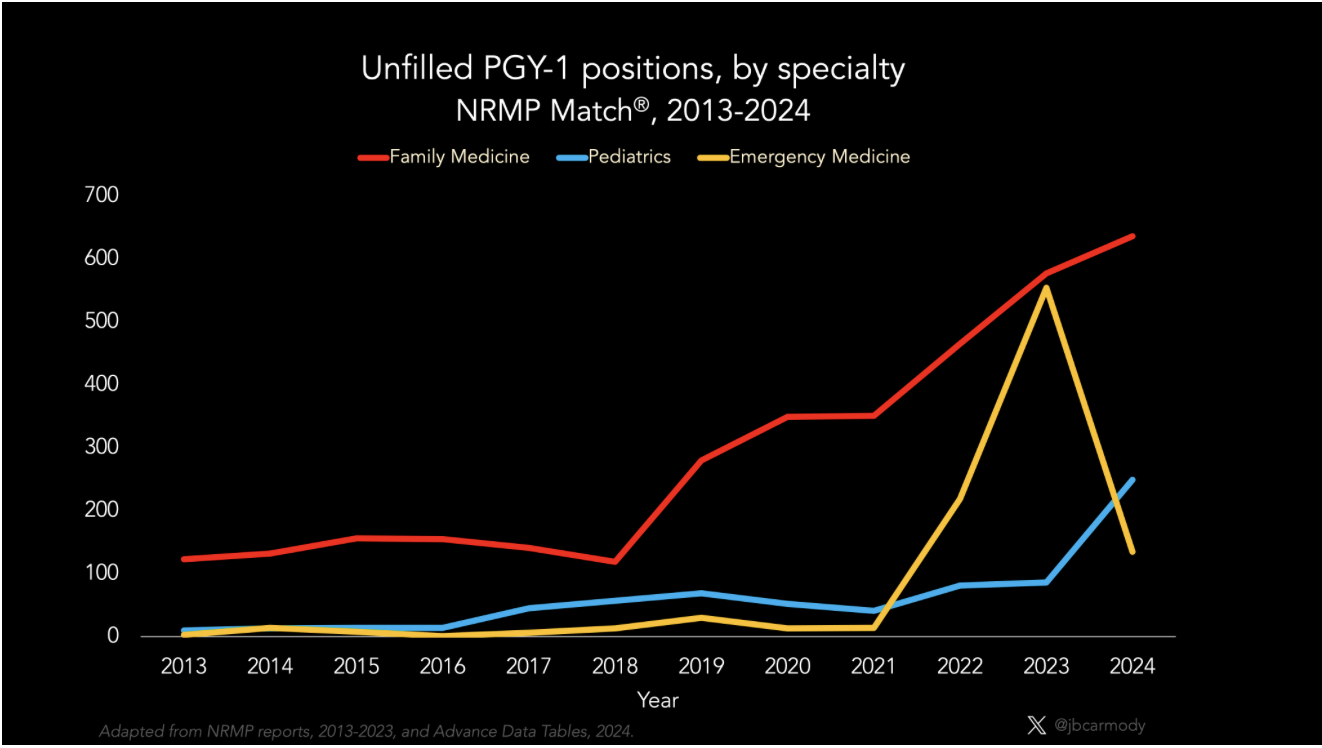
For several years, numerous reports have cited a growing residency shortage, but if someone looked at just the FM and pediatrics data, they would think there was a residency slot surplus. Open slots ultimately get filled after the SOAP or Scramble process where those who didn’t match get to do a lightning round application to all the programs which didn’t fill. What usually results is those who didn’t match into the specialty they actually wanted to go into, such as dermatology or orthopedic surgery, end up in the less desired family medicine or pediatrics. As the delta between available spots and matched students grow, so will the number of students who SOAP into family medicine. Family medicine currently already suffers from hospital systems turning primary care into referral mills, nurse practitioners claiming equal skill for increased independent practice, and high levels of burnout. Imagine placing someone who never wanted to do family medicine to begin with into this milieu. The short term increase in residency positions by increasing the number of slots without a concurrent increase in family medicine interest could accelerate the collapse of primary care as we know it.
Five years have passed since the AAFP announced its 25×2030 initiative and clearly whatever was tried in the first half did not work. Incidentally, the DPC Alliance started the same year and the DPC community has grown tremendously in the same time period. Students pick their specialty based on their experience during rotations and general attitude toward a specialty. Most students will rotate through hospital-based, fee-for-service family practices and hear the usual patronizing talking points from specialists about family medicine. DPC doctors have an outsized ability to participate in medical education and perhaps begin to fix the pipeline issue for all of family medicine. The current academic medical centers and insurance-based primary care system haven’t and certainly won’t start any time soon.








This is another superb bit of research and data analysis from Dr Qiu, This movement needs this information, particularly in our work in Congress. In truth, we should be advocating for a goal of Primary Care growth in the 3-4x direction, not in the stagnant growth we currently see. This will require an overhaul of the financial allotment going to Primary Care physicians and also an elimination of fee-for-service embursement and “risk sharing” arrangements. Thanks Kenneth for the insights.
It used to be that the ratio of interviewees to spots was 10:1. That usually meant that a program would fill. And back when there were slightly more spots than applicants this was good advice. Now that there are far more applicants than spots, many programs have shifted to a 8:1 ratio. Reasons? 1) the quality of the candidates in the SOAP has dramatically improved so why would a residency spend tons of effort building the bottom of their list? 2) Since some applicants are taking 40+ interviews the yield was increasingly lower so they focus on those who they feel they stand a chance with. 3) As there are more spots open in SOAP, some applicants, instead of interviewing for a second choice specialty during the interview season, are saving the effort and just using the SOAP. Classic examples being Ortho now going for FM with Sports Med or OB/Gyn shifting to FM with OB.
With interviews now being largely virtual, the lightning round isn’t dramatically different than the real thing. I even know of a few residencies that basically do little recruiting before SOAP as it is much more effective to find a class in the SOAP.
I wish it wasn’t so, but I only see the trend accelerating. Frankly, in my opinion, given the virtual nature today of picking a residency, I think one could make the argument to move the whole match to December, with a follow up in March for those who missed the first round.
PS: Carmody is King on the Match and Dr. Bliss is spot on with his solution.