Do Medical Schools Need to Expose Students to Direct Primary Care?
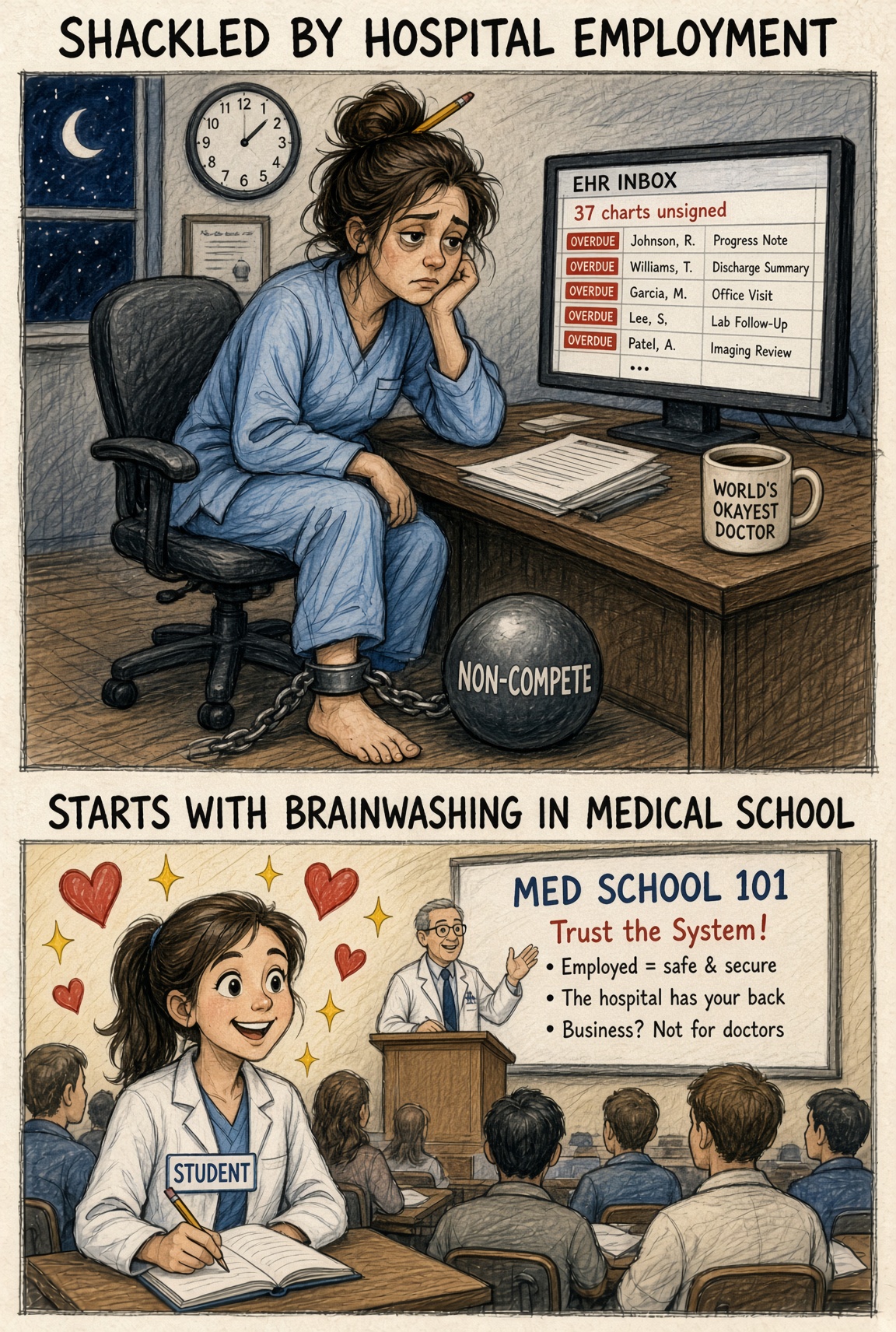
The image above may come across as a little harsh, but is it true?
I think it is.
Being employed by big hospitals or corporations is a major risk for burnout. Physicians continue to be affected by this.
- Depression
- Substance abuse
- Divorce
- Suicide
- Quitting the profession
The AMA has been talking about how to fix this forever.
The AMA’s overall Physician Well-Being Program, which also includes research, measurement tools, advocacy (including on regulatory burdens), conferences (e.g., co-sponsored American Conference on Physician Health), and resources to address root causes of burnout rather than individual resilience alone, started in 2013.
How has that worked out? It’s laughable, actually.
One of the ONLY things to help primary care physicians is Direct Primary Care. I am not saying it is perfect because being a doctor is hard. Sometimes, very hard. But it is infinitely better than being employed, coding, doing useless quality metrics, sitting on stupid committees, and fighting for RVUs.
My question is whether the indoctrination to being employed starts in medical school? Usually, the first two years are in the classroom, but when the students start rotating, how many actually see happy doctors? How many are exposed to family medicine that is not the 25 patient per day grind?
How many see what Direct Primary Care is all about?
For shits and giggles, I asked an AI agent to review my published books and create a curriculum. Here is what you get:
📚 Direct Primary Care Curriculum for Medical Students
🎯 Course Objectives
- Understand the foundational principles of Direct Primary Care and its contrast with the traditional insurance-based model.
- Evaluate the ethical, financial, and practical considerations of launching a DPC practice.
- Explore the patient-doctor relationship within a DPC framework.
- Gain early exposure to entrepreneurial thinking in medicine.
- Develop a roadmap for post-residency transition into DPC.
🗓 Course Modules Overview
Module Title Summary 1 The Philosophy of DPC Historical roots, modern challenges in primary care, and DPC’s reimagining of medical autonomy. 2 Deciding if DPC is Right for You Self-assessment: personality traits, financial considerations, and readiness for risk and independence. 3 Leaving Employment Behind Practical and legal guidance on exiting employed practice, including non-compete clauses and information retention. 4 Launching a DPC Practice Step-by-step planning, including location, office setup, legal structure, staffing, and branding. 5 Pricing, Services, and Revenue Models How to set transparent fees, structure monthly rates, offer add-on services, and manage affordability. 6 EMR and Administrative Structure Choosing DPC-friendly tools, patient charting practices, and keeping overhead low. 7 Marketing and Growth Strategies Building visibility through local media, digital presence, public education, and leveraging word-of-mouth. 8 College & Business Outreach Partnering with schools and small businesses to expand patient base in creative and ethical ways. 9 Patient Experience and Retention Strategies for delivering memorable, personalized care that fuels organic practice growth. 10 Managing Challenges & Burnout Prevention Real-world lessons on patient churn, ethical boundaries, vacation policies, and dealing with difficult cases. 11 DPC Metrics and Success Rethinking “quality” outside of insurance-based constraints—TWP (Time With Patient) and true outcomes. 12 Exit Strategy and Practice Sale Valuation, succession planning, and ensuring patient continuity. 13 The Future of DPC Legislative updates, DPC alliances, advocacy, and integrating DPC principles into broader healthcare reform. 🛠 Capstone Project
Students will create their own mock DPC practice:
- Define mission & vision
- Outline patient membership tiers and services
- Design branding and patient experience strategy
- Draft a basic launch plan with budget
- Present a marketing pitch to peers
🧠 Teaching Methods
- Guest lectures from practicing DPC physicians
- Live case studies (e.g., mock meet-and-greet roleplay)
- Guided financial models & pricing simulations
- Journal reflection prompts (inspired by The DPC Doctor’s Daily Motivational Journal)
- DPC debate sessions: “Is traditional FFS medicine broken?”
🧭 Optional Reading List
- The Official Guide to Starting Your Own DPC Practice by Douglas Farrago, MD
- Slowing the Churn in Direct Primary Care by Douglas Farrago, MD
- Patients at Risk by Niran Al-Agba, MD and Rebekah Bernard, MD
- Start With Why by Simon Sinek (entrepreneurial mindset)
📝 Direct Primary Care Course Syllabus
Course Title: Reimagining Primary Care: Direct Models for Patient-Centered Practice Audience: Medical Students (Years 2–4 or Primary Care Track) Credits: 1–2 units (elective/longitudinal format) Instructor: Guest DPC Physicians / Faculty Facilitator Duration: 6–12 weeks
🎯 Learning Goals
By the end of this course, students will:
- Understand the ethical and structural challenges of traditional primary care.
- Critically evaluate the DPC model as a patient-centered alternative.
- Develop entrepreneurial and leadership skills relevant to modern practice.
- Design a mock DPC practice including branding, pricing
🔍 1. “DPC Audit” of an Existing Practice
Students investigate a traditional primary care clinic (real or fictional) and conduct a comparative analysis:
- Identify 5 broken systems or inefficiencies
- Propose DPC-style solutions (pricing, access, experience)
- Present to class as a “practice rescue pitch”
📝 Assessment Focus: Systems thinking, critical evaluation, cost-conscious creativity
🎬 2. One-Minute Mission Video
Students script and record a short video as if launching their own DPC practice:
- State their “Why” in under 60 seconds
- Define patient experience in 3 bold statements
- Create a name, slogan, and logo mock-up
📝 Assessment Focus: Communication, personal values, branding clarity
💬 3. Patient Scenario Roleplay
Roleplay a real-world DPC “meet-and-greet,” but make it tricky:
- Patients may be skeptical, have chronic complex issues, or question pricing
- Students must build trust, explain the model, and stay within ethical boundaries
📝 Assessment Focus: Empathy, persuasive communication, patient education
🎨 4. Design Your Waiting Room
Have students sketch, moodboard, or digitally render their ideal DPC space:
- Include patient flow, comfort details, design ethos
- Bonus: Annotate how each design element supports trust, privacy, and well-being
📝 Assessment Focus: Environmental design, patient psychology, branding alignment
📈 5. DPC Growth Challenge
Give students 3 months of fictional patient data: churn, interest, press coverage, referrals. Their task: draft a growth response plan using:
- Outreach letters
- Facebook post mock-ups
- Referral script
- Churn analysis
📝 Assessment Focus: Marketing strategy, retention, data-based iteration
🔓 6. “Escape the Admins” Simulation
Students take on the role of a burned-out doc in an employed setting.
- Present a “burnout-to-DPC” roadmap
- Must include 3 ethical dilemmas, a legal review of their contract, and a timeline for exit
📝 Assessment Focus: Strategic planning, legal awareness, personal autonomy
✍️ 7. Write Your Own DPC Consumer Guide
Inspired by Dr. Farrago’s appendix, students craft their own version with:
- Local patient FAQs
- Common myths
- Empathy-driven storytelling
- Optional visual layout
📝 Assessment Focus: Health literacy, clarity, patient-centered writing
🧠 8. DPC Myth Debunking Debate
Students split into teams: “DPC Critics” vs. “DPC Champions”
- Use real quotes from EMR vendors, insurers, and critics
- Each team prepares opening statements, rebuttals, and closing arguments
📝 Assessment Focus: Critical
What do you think? I didn’t change anything, and it obviously needs tweaking, but it’s not bad.
Maybe this is a pipe dream, but the reason I continue to be involved in DPC is the hope that we can unshackle at least primary care doctors from the chains of being employed by big hospitals or corporations. It is not for everyone. I get that. That being said, I believe it is the best path for most.
And it should start in medical school.
Remember, National DPC Day is November 1, the day when people start enrolling in insurance plans. Get the word out by sending them here. For doctors, read this.






I still don’t like the term “burnout.” It implies that the physician is the problem and needs to be fixed through self-help, better time management, or improved coping skills, rather than addressing the system they work in. To me, that framing borders on victim-blaming.
Valid. But at what point is the responsibility of the physician to leave the system to escape the problem?