The Primary Care Death Spiral: Losing Our Horizon
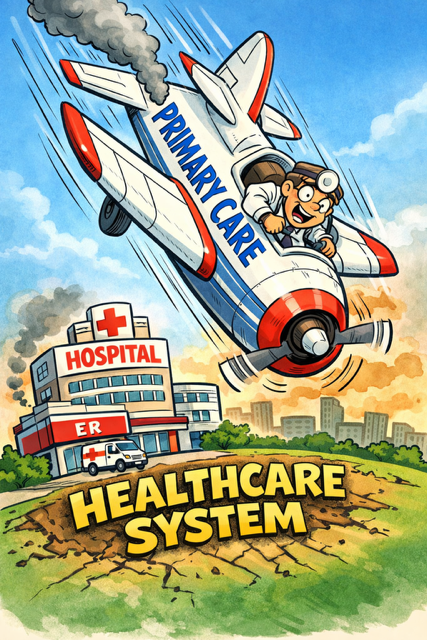
In the 2026 NRMP Main Residency Match, family medicine offered a record 5,512 positions yet filled only 83.6 percent, leaving 899 spots unfilled before SOAP (formerly known as the “scramble”). Internal medicine (554 unfilled) and pediatrics (179 unfilled) also posted lower fill rates than in prior years. These numbers are not an anomaly; they reflect a five-year downward trend.
They signal that primary care is locked in a classic “death spiral”—the same phenomenon that has doomed countless pilots.
Let me be clear upfront: I am not a pilot. But the mechanics of a graveyard (death) spiral offer a useful analogy—an interplay of physics and physiology. A pilot flying in clouds or at night loses sight of the horizon. The airplane gradually enters a banked turn and begins to descend. Because the change is subtle, the pilot’s inner ear does not detect the turn; the body feels perfectly level.
Instinctively, the pilot pulls back on the control stick to climb and may even bank further to “correct” the false sensation. These natural reactions tighten the spiral and accelerate the descent until the aircraft corkscrews into the ground. The only escape is to ignore bodily instincts and trust the attitude indicator—the instrument that shows true level flight (true horizon). In simple terms, the pilot must level the wings.
Primary care is the horizon of the healthcare system. It provides the reference point for prevention, early diagnosis, chronic disease management, and care coordination. When that horizon disappears, the system becomes disoriented and begins its own deadly spiral.
Consider the parallels:
1. Loss of visual reference
Medical students see the reality: primary care pays far less than most specialties, carries crushing administrative burdens, and demands longer hours for relatively modest rewards. They vote with their feet and choose other fields. Primary care positions go unfilled.
2. Gradual bank and descent
Fewer new physicians enter primary care. Veteran doctors retire early, burn out, or move into non-clinical roles, like administration. Patient panels expand, while rural clinics and inner-city practices close.
3. False sensation and incorrect correction
Patients lose access to a regular physician and turn to emergency departments, urgent cares, and specialists for routine care. Care becomes fragmented, preventable hospitalizations increase, and costs rise. The remaining primary care physicians face even larger panels and heavier workloads, accelerating burnout and further attrition.
4. Accelerating spiral
Healthcare spending climbs, quality erodes, and access deteriorates—especially in the communities that need care most. Specialists become backlogged, hospitals see higher-acuity cases, and public frustration grows. Each attempted fix—expanded insurance coverage, increased reliance on non-physician providers, more specialists, more technology—often steepens the dive, much like a pilot pulling back harder on the control stick.
Like a pilot who refuses to trust the instruments, our system keeps pulling back on the stick instead of leveling the wings. The instruments we need are not complicated: pay primary care in proportion to its value, reduce administrative waste, restore price transparency, and rebuild the long-term doctor–patient relationship.
These goals can be achieved by learning from and implementing the direct primary care model.
Until policymakers, hospital leaders, medical educators, and even primary care physicians themselves commit to restoring primary care as the system’s horizon, the spiral will continue. And like the pilot who ignores the attitude indicator, we may not recognize how steep the descent has become—until impact.
Direct primary care can serve as the attitude indicator, pointing the way back to level flight. Medical students need to learn to “fly by their instruments” and understand how the system truly functions. They need exposure to DPC in action so they can see a viable, hopeful path in primary care.
Current DPC physicians, in turn, must mentor the next generation—helping them chart their own course without crashing within the system.
Then, maybe—just maybe—we can begin filling primary care residency positions again.








EMR has killed it due to the more administrative B.S. If med students are assigned an F.P. or I.M. compatriot doc during training to follow, they likely find out all the b.s. the docs have to do and decide, “Not for me specialty for me!” I don’t blame them. Only ones left going into primary care are those who don’t match into the specialty they wanted to do originally. They’re faced with, “I gotta do something!”