BWCA and DPC
I grew up in the Midwest in a family of four boys that loved the outdoors. Most family vacations were spent camping. My dad was an avid hunter and fisherman. Minnesota, land of 10,000 lakes, has some of the nation’s best fishing. The Boundary Waters Canoe Area (BWCA) is an outdoor paradise and a fisherman’s delight. Growing up in Minnesota, I had heard from other BWCA travelers about how amazing the experience was, both from the grandeur of nature and the amazing fishing. Despite my outdoors-y up bringing, I had never had an experience quite so, well, primitive.
The BWCA is majestically pristine, beautifully peaceful and mercilessly deadly if you don’t know what to prepare for. For perspective, the BWCA is accessible only by canoe, but you can only travel so far by water before you need to get out to go around rapids, waterfalls or move from one lake to another through wilderness trails called portages. You must pack out everything that you pack in, and you will need to pack everything you need. Only so many groups are allowed at any entry point at any given time. You absolutely need a compass and a map to find the portages between waterways; there are no signs. It’s possible to go days without seeing other people. There is the threat of bears and wolves, and mosquitos (tiny but mighty – underestimate them at your peril). Campsites consist of a fire grate, and about 20 to 30 yards back in the woods, a hole in the ground with a seat for a bathroom.
There’s two ways to learn how to both survive and thrive in the BWCA. One is hiring an outfitting service with a guide. The second is to have some knowledgeable and experienced friends invite you along for a trip and show you the ropes.
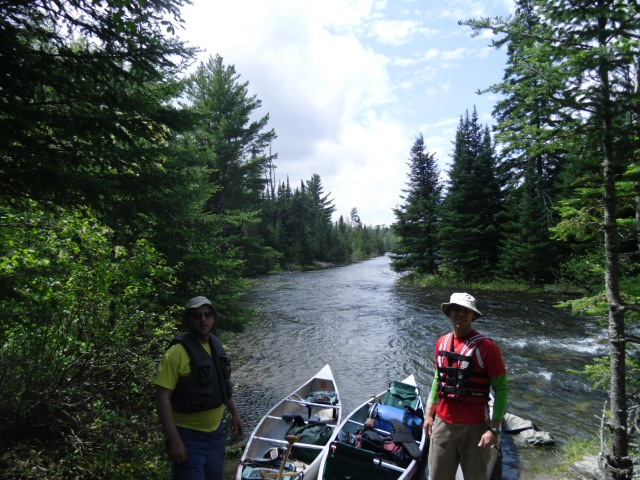
One of my brothers went along with a family that had been taking BWCA trips for years. He fell in love with it. He started taking my other brothers. When I completed my medical training, I was invited along for a trip. The picture above was taken at a portage with my guides, my brother, Dave, and my other brother Steve. Soon, we decided that we wanted our kids to experience this special place. We’d been taking an annual BWCA trip for years. On our third trip we encountered a severe storm. It was one of the scariest canoe rides of my life. I had tennis elbow for the rest of the summer from paddling so hard. About a week after we got back to civilization, we learned that two young men died on the same (really, really big) lake we were on, the same day we were there in the storm. There are 2 to 3 deaths every year in the BWCA.
Recently, Doug Farrago wrote an article lamenting the relatively small number of physicians who are making the switch to direct primary (and specialty) care. There was an animated video that accompanied the blog post showing people walking off a cliff until one put a board across and successfully traversed the chasm. The next person kicked the board to the side, fell to their death, and the carnage continued.
This won’t be a perfect analogy but may be helpful. It strikes me that many of our colleagues who are looking at making the switch to DPC see it similarly as going into the BWCA. It promises a lot of amazing and fulfilling adventure but also has some very real danger. While there are plenty of books and blog posts about preparing for and traveling in the BWCA, none of those are the same as going there in person with a guide, whether hired or a friend. There are plenty of books, blog posts and even conferences about switching to DPC. The DPC University website run by the DPC Alliance is a fantastic resource, but it’s still not the same as “going in person”.
We should get the HINT (pun intended) about why so many DINOs, DPC-ish, DPC-esque, para-DPC and DPC adjacent organizations are popping up. While some may only be interested in turning a profit, others may be legitimately trying to serve as an outfitter and/or guide. From the outside, DPC seems primitive. (You take your own vitals, clean your clinic, answer your phone directly, etc. – that can be viewed as lower than a scut monkey!) Some of these organizations may be useful for a time. But outfitters and guides always cost more in the long run.
So, my challenge to the DPC community: figure out how to take others on a DPC outing. How does that look? Volunteer to give a talk at a pre-med student group, medical school or residency. Allow pre-med students, medical students and residents to shadow and rotate with you. When DPC is imprinted upon them and then they experience third party, fee-for-service brokenness, it won’t be hard to reel them back in!
Once your practice is full, start a waiting list and look for a partner. This may be someone you employ. I didn’t want to go that route for several reasons. When God put another like-minded physician who wanted to learn the ropes in my path, we made a simple business agreement to split the “lights and lidocaine”. I kickstarted his patient panel with my waiting list. We had an agreed-upon percentage that he would pay me each month for the first year of practice, in addition to splitting the lights and lidocaine. This arrangement motivated me to help fill his practice sooner because I would get a larger percentage each month. Since his practice was independent (he ate what he caught – common in the BWCA because if you don’t catch it, you carry it in), he was motivated to grow so that he could make rent and feed his family. He was full in a year.
The local Family Medicine residency program has some promising graduates that are very interested in DPC. We are exploring the idea of hammering out a similar contract for them, starting a waiting list, and having them start to recruit patients in the last six months of their training so they can hit the ground running. This strategy may work for some of you as well.
As I said, this analogy is not perfect. One of the imperfections is that more of our colleagues are going to die, literally, staying in the broken fee-for-service system than adventuring into DPC. Heartbreakingly sad but true. DPC, like a comma, can save a life. (“Let’s eat Grandma!” is very different from “Let’s eat, Grandma!”) Give some serious thought to being a guide for that interested but reticent colleague or that curious student or resident.