A Racecar Driver is Only as Fast as the CAR
I want to give credit where it is due, with regard to these management orgs that I talked about in my recent article Tell Me I Can’t.
They actually can arrange true DPC. Good patients for good DPC docs needing numbers, good care for employees, savings for employers, etc. and some do it at a quite minimal operational/administrative expense–I’ve seen it as low as $5/mo which is respectable! Not all are so transparent, but I’ve even seen this being done quite transparently, and even if it’s too middleman-ey for my taste, it’s not horrible in some cases, even if there’s a good argument that it’s unnecessary.
I’ve seen it improve the healthcare experience of patients, at least in comparison to their experiences inside the system. But if those patients cut out the employer, or if that employer cut out the management org, that experience could still be better, and that brings me back to the point I really want to make today. The bigger something gets, the harder and slower it moves. It’s just physics.
The counterargument (that is defeatist) to this natural fact is “don’t let perfect be the enemy of good.” But if closer to perfect is being accomplished, why on earth would you dilute it down to good? I mean, that’s a big part of why I, for one, left the system–I couldn’t practice full-spectrum family medicine as well when I had middlemen, bureaucracy, insurance, and government garbage always coming between my patients and I and undercutting my autonomy. I mean, I wasn’t a bad doctor- but I KNEW I could be better if unencumbered. If DPC is closer to perfect sans middlemen/administration, then why bog it down with them?
So I’d like to introduce, yes, another analogy. I know. I can’t stop myself.
Arguments for the alphabet soup management orgs have all these positives, about how they sell insurance products and work with cost shares and have wellness coaches and offer this, and offer that. Enter into my highly visual mind the elite racecar driver. When I hear about all the stuff they claim to have/be/offer, I think about all the reasons a racing team would hire a great driver. The driver has super-human reflexes and will avoid wrecking your multi-million dollar car. The driver has no fear, years of experience, a room full of trophies, etc.
And yes, I get it that the driver is good. But given certain race conditions, all that might just be irrelevant.
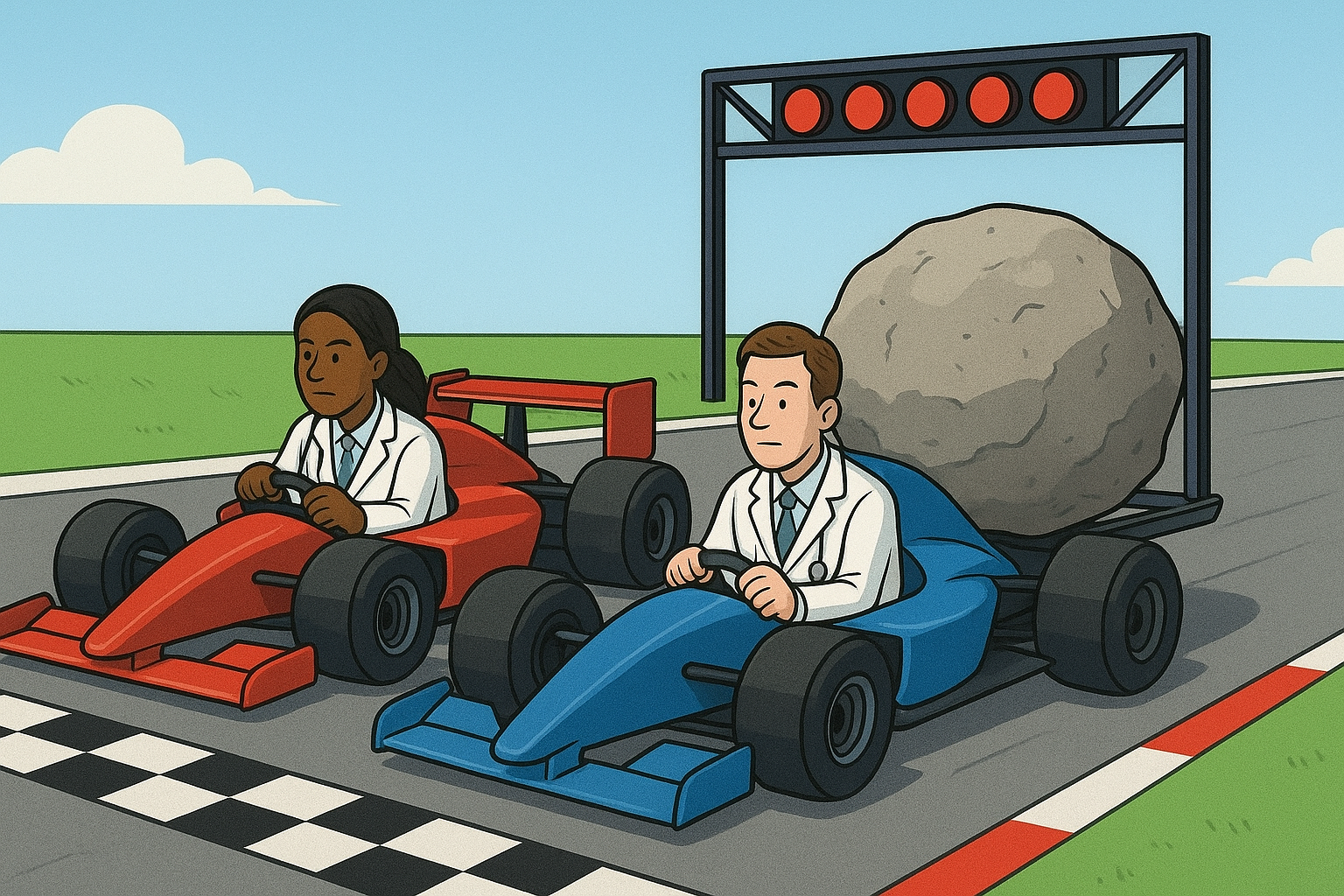
And this is how I know I could beat such a driver in a race. Pick your favorite F1 or NASCAR driver, and have them race me. We can even drive identical cars. And I’ll beat them.
“WHAT?! You cocky so-and-so! How could you make such a bold and audacious claim!!?” Well, because I know the system of the proposed race – although we both drive a fast car, my opponent’s car will have a heavy chain attached that is hooked to a high-friction sled bearing 2,000 lbs of dead weight. And I’ll win.
Obviously, as good of a driver as I may fancy myself to be, in a fair race, I would not stand a chance racing an elite driver! But I can still be assured of victory if I know that the system gives my car great potential and severely limits my opponent’s. Everything the elite driver is capable of, and all that makes me inferior–becomes irrelevant.
This is how I think about these organizations with dozens of administrators. With deals with insurance companies that demand coding and metrics. With deals with VC and PE, who expect massive profit margins. With deals with government entities that constantly change the goalposts.
All of that describes a hospital! We know where this road goes, and nobody’s going back.
Just like I can confidently beat a severely handicapped elite driver, DPC docs can put the quality of their clinic’s care up against that of most any family doctor inside the system, even if we know nothing about that doctor–just knowing they work in the 3rd party FFS system is enough to know our patients are better off, and our doctors more satisfied! We can do that because we know our system is not affected by administrative burdens and we know all the cool stuff we can do for them and that the system can’t. (And the know all the complicated garbage that the system hassles them with that we don’t.)
Some of these DPC-adjacent management organizations are already gravitating toward the behavior of the system, requiring much more from its medical staff than just good care. “Necessary evils” I’ve heard it called. Billing, coding, tracking meaningless metrics, and being slowly asked to see more and more patients for shorter and shorter durations. Limiting patients to one complaint per visit. Loss of autonomy- people in-between doctors and patients. All of the moral injury.
All of that is required to work with third-party payers–and the system does it, because the people with the money demand it. You work for who pays you, and now you’re paying attention to the payer, not the patient. This is no different outside of the system when 3rd party payers get involved.
And what about all that administration? Do they not require salaries (sometimes grossly high ones?) Who pays them? Of course, it is their patients, one way or another. Whether it be higher membership rates or money paid by their employer- it’s money those employees or patients aren’t going to see in their paychecks, that’s for sure.
I’ve been accused of speculation with regard to that “negative projection.” But it’s not speculation. It’s happening already. I recently spoke with a friend and former colleague who has experienced it. She went to work for a real DPC. She was in heaven. She had a panel of ~500 with a practice of authentic primary care in a DPC model. Soon the DPC she worked for sold out to a DINO who then sold out to Amazon (OneMedical). I’m sure the business owners who sold out are happy on a beach somewhere, but their employee…now she is back to seeing 20+ per day under threat of penalty, and has all the boxes to check, loss of autonomy, moral injury, etc. Her words: “The DPC has become indistinguishable from when I worked for the hospital-owned clinic” where she worked for 20 years. And does anybody think her patients’ care is as good now as it was? Come on.
This is not theoretical. It is already happening. A great driver can only do so much with an overloaded car; it’s just the laws of physics.